
Home / RV flexible solar panels / Golf carts and low-speed vehicles
Solar roofs for golf carts, without a high-voltage panel
A golf cart battery runs at 36 V or 48 V, well above the 18–20 V a standard panel gives. The usual answer is a custom high-voltage panel. Ours is simpler. We fit standard flexible panels to the canopy and add a boost MPPT controller set for your battery.
At a glance
Standard flexible panels plus a boost MPPT controller for 36 V and 48 V carts, for cart makers and accessory brands.
- Power range
- 50–200 W, 5 models
- Weight
- 1–3.5 kg (2.1–7.7 lb)
- Recommended models
- USF-50H, USF-100H, USF-115H, USF-150H, USF-200H
- Cells
- HPBC, over 26% cell efficiency
- Thickness
- 2.6 mm (0.10 in)
- Warranty
- 3 years
- Minimum order
- 50 pcs per model
- Samples
- 7–10 days (10–15 days for custom sizes)
- Mass production
- 25–35 days after sample approval
What this application demands
- The battery voltage is higher than the panel'sA 48 V lead-acid pack charges at about 57–58 V. A standard panel works at 18–20 V, so a controller has to raise the voltage.
- Canopies are small, curved and often shadedRoof sizes differ from model to model, many tops curve, and trees, buildings and passengers shade them through the day.
- Weight and price both matterA canopy isn't built to carry a framed glass panel. A cart is also a price-sensitive product, so the panel has to earn its cost.
Panels for golf cart canopies
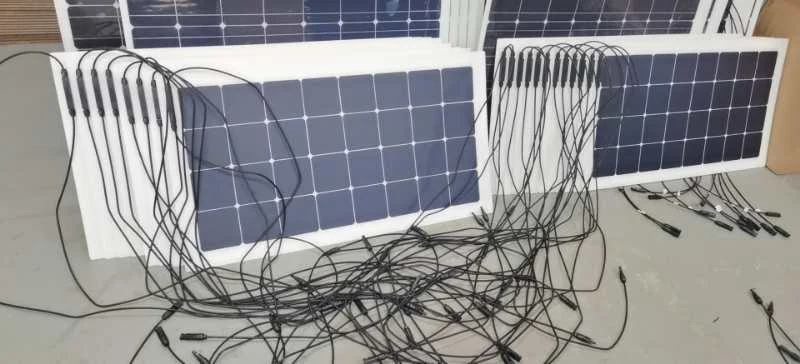
All of these work at about 18–20 V, so one boost controller suits any of them. Choose by the flat area of the canopy, and mix sizes when one panel doesn't fill it. If none of them fits your roof, we make custom sizes from 50 pieces.
| Model | Power | Vmp / Imp | Voc / Isc | Size | Weight |
|---|---|---|---|---|---|
| USF-50H | 50 W | 20 V / 2.5 A | 25 V / 2.66 A | 640 × 400 mm25.2 × 15.7 in | 0.96 kg2.1 lb |
| USF-100H | 100 W | 20 V / 5 A | 25 V / 5.32 A | 840 × 580 mm33.1 × 22.8 in | 1.82 kg4.0 lb |
| USF-115H | 115 W | 18 V / 6.4 A | 22.5 V / 6.8 A | 990 × 580 mm39.0 × 22.8 in | 2.14 kg4.7 lb |
| USF-150H | 150 W | 20 V / 7.5 A | 25 V / 7.98 A | 1220 × 580 mm48.0 × 22.8 in | 2.64 kg5.8 lb |
| USF-200H | 200 W | 20 V / 10 A | 25 V / 10.6 A | 1220 × 770 mm48.0 × 30.3 in | 3.51 kg7.7 lb |
Who this is for
- Golf cart and low-speed vehicle (LSV) makers adding a solar roof to a model.
- Accessory brands selling solar tops or charging kits for carts already on the road.
- Resorts, campuses and communities running cart fleets.
Why not a 48 V or 72 V panel?
To charge a 36 V or 48 V battery without a boost controller, the panel’s voltage has to stay above the battery’s charging voltage all day. That means a custom panel with a long chain of cells in series. We usually advise against it.
| What changes | High-voltage panel | Standard 18–20 V panels + boost controller |
|---|---|---|
| Cells in one series string | Roughly three times as many for a 48 V battery | 36 cells per panel |
| One shaded cell | Holds back the whole long string, with a higher hot-spot risk | Affects only its own panel when wired in parallel |
| Current at the same power | Low | About three times higher |
| Open-circuit voltage | Usually above 60 V DC | About 25 V per panel |
| Fitting the canopy | One fixed size | Mix 50–200 W panels to fit |
| Replacement | A custom part | A standard part |
Many safety standards treat up to 60 V DC as safe to touch in dry conditions, and set lower limits for wet ones. A panel that stays around 25 V is far inside that, which makes wiring and service on the cart simpler.
How we set up a cart
- Measure the canopy. Send us the flat area and the curve, ideally with a drawing or a sample top.
- Choose the panels. We match one or more panels from the table above to the area, or make a custom size.
- Wire them in parallel. Each panel works on its own, so shade on one doesn’t pull down the others, and the voltage stays below the battery’s.
- Pre-set the controller. We set the boost controller to your battery’s charging voltage before shipping, so nobody has to program it on the cart. That’s why we ask for the battery details below.
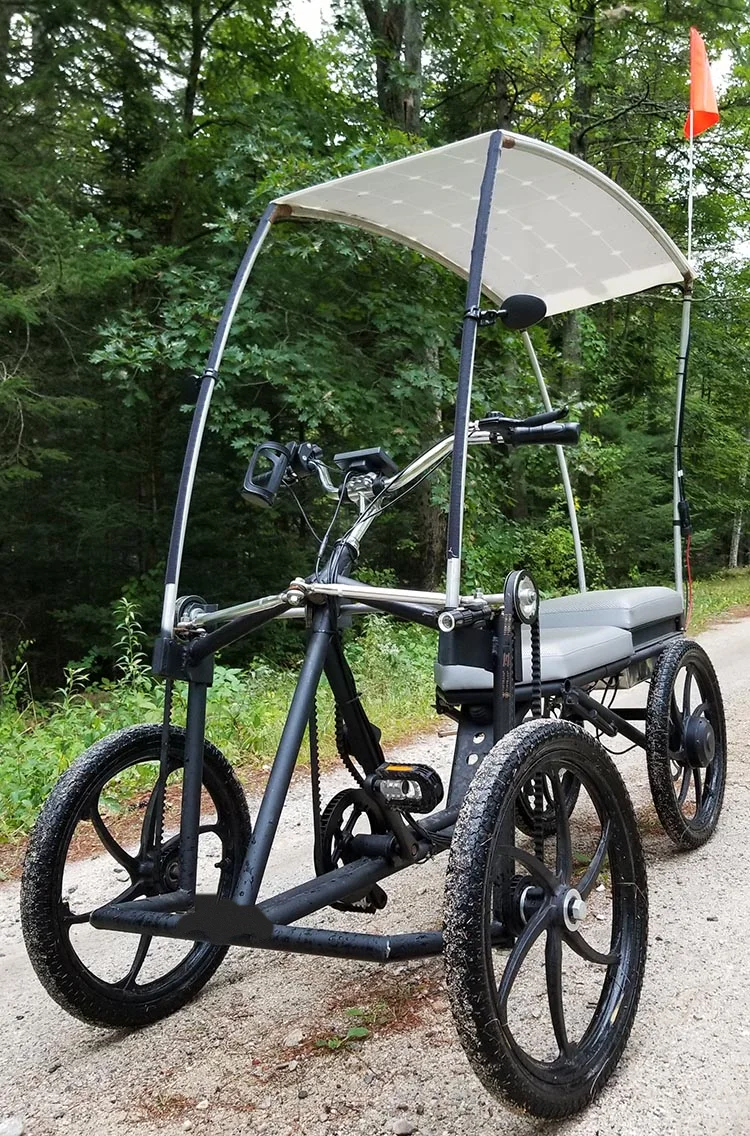
- Fix the panels with an air gap. As on RV roofs, we don’t recommend gluing a flexible panel straight onto the canopy. On some vehicles the panel is the canopy itself, spanning a curved tube frame with open air underneath. See how to mount flexible panels.
Typical battery voltages
| Nominal pack | Common build | Typical charging voltage |
|---|---|---|
| 36 V | Six 6 V lead-acid batteries | About 43–44 V |
| 48 V | Lead-acid (six 8 V or four 12 V) | About 57–58 V |
| 48 V (51.2 V) | Lithium iron phosphate (LiFePO4) | About 57–58 V |
Typical values only. We pre-set the controller to your battery maker’s charging specification, not to this table.
A real example
This one isn’t a golf cart, but it had the same problem. A US maker of a pedal-assist electric vehicle asked us for a high-voltage panel to charge the 48 V battery under its roof canopy. After going through their battery setup, we recommended our standard 18–20 V flexible panels with a 300 W boost MPPT controller instead. Their tests went well, and they have reordered for years, using 50 W, 100 W and 140 W panels to fit different roofs. Read the case.
What we need from you
To quote, we only need two things:
- Your battery voltage and type, for example 48 V lead-acid
- The canopy size. A photo with a tape measure on it is enough.
We’ll ask about the rest, such as the controller, when we reply.
More on the controller side: charging 36 V and 48 V batteries from standard panels.
Questions buyers ask
Which battery voltages do you support?
36 V and 48 V carts, plus 60 V and 72 V systems, with a 300 W or 600 W boost MPPT controller. The panel voltage must stay below the battery voltage, which is why we wire the panels in parallel.
Can a solar roof fully charge a golf cart?
Usually not from empty. As a rough guide, a 200 W canopy gives about 0.5 kWh on a day with four hours of strong sun, while a 48 V, 100 Ah lead-acid pack stores about 4.8 kWh. Solar tops the battery up while the cart is parked or driving, adds some range, and keeps the pack from sitting partly discharged. Plug-in charging is still needed.
Do we have to buy the controller from you?
No. We can supply a boost MPPT controller, pre-set to your battery and tested with the panels, or you can source your own. If you buy your own, it must be a boost or buck-boost MPPT type that accepts a panel voltage below the battery voltage, set to your battery maker's charging specification.
Are flexible panels more expensive than rigid ones?
Yes. Per watt, a flexible HPBC panel costs more than a framed glass panel. It pays off when the canopy can't carry a frame and glass, when the top curves, or when you want a low, clean profile. If your canopy is flat and strong enough for a framed panel, a rigid panel may be the cheaper choice, and we'll tell you so.
What is the minimum order?
50 pieces per panel model. We supply cart makers, accessory brands and fleet operators, not single carts.
Other applications
Camper van conversions
Low-profile panels that fit between roof rails, fans and racks on converted vans.
Read moreTravel trailers and fifth wheels
Higher-wattage panels that cover larger roofs without adding glass weight.
Read moreTruck campers and overland rigs
Panels built for corrugated roads, branches and constant vibration.
Read moreRV manufacturers and rental fleets
Locked specifications, QC reports and written limits for factory-fit solar.
Read moreRelated guides
 November 22, 2026
How much solar power does an RV get in winter?
A 400 W flat roof array makes roughly 1 kWh a day in a southern Arizona December, and under half that in the northern states. Why winter output drops, and how to get more.
November 13, 2026Field case: a 5 cm shadow cut a panel to 30% of its power
A real customer case. Why a small shadow next to an air conditioner crippled a flexible panel, why the 48 V battery stopped charging, and how we are fixing it.
November 13, 2026Flexible vs rigid solar panels for RVs: which should you choose?
Weight, height, durability, heat and cost compared. When flexible panels beat rigid glass panels on an RV, and when they don't.
Tell us what you're building
We reply to B2B inquiries within 24 hours, with prices for your quantity and the models that fit your application.
- Emailinfo@sola-e.us
- Phone and WhatsApp+86 189 9893 8496
- FactoryTongyuan Science Park, No. 1 Qiaojiao Middle Road, Tangxia Town, Dongguan, China
- CatalogDownload the product catalog (PDF)