
Home / Testing and quality
Why we test for what happens after delivery
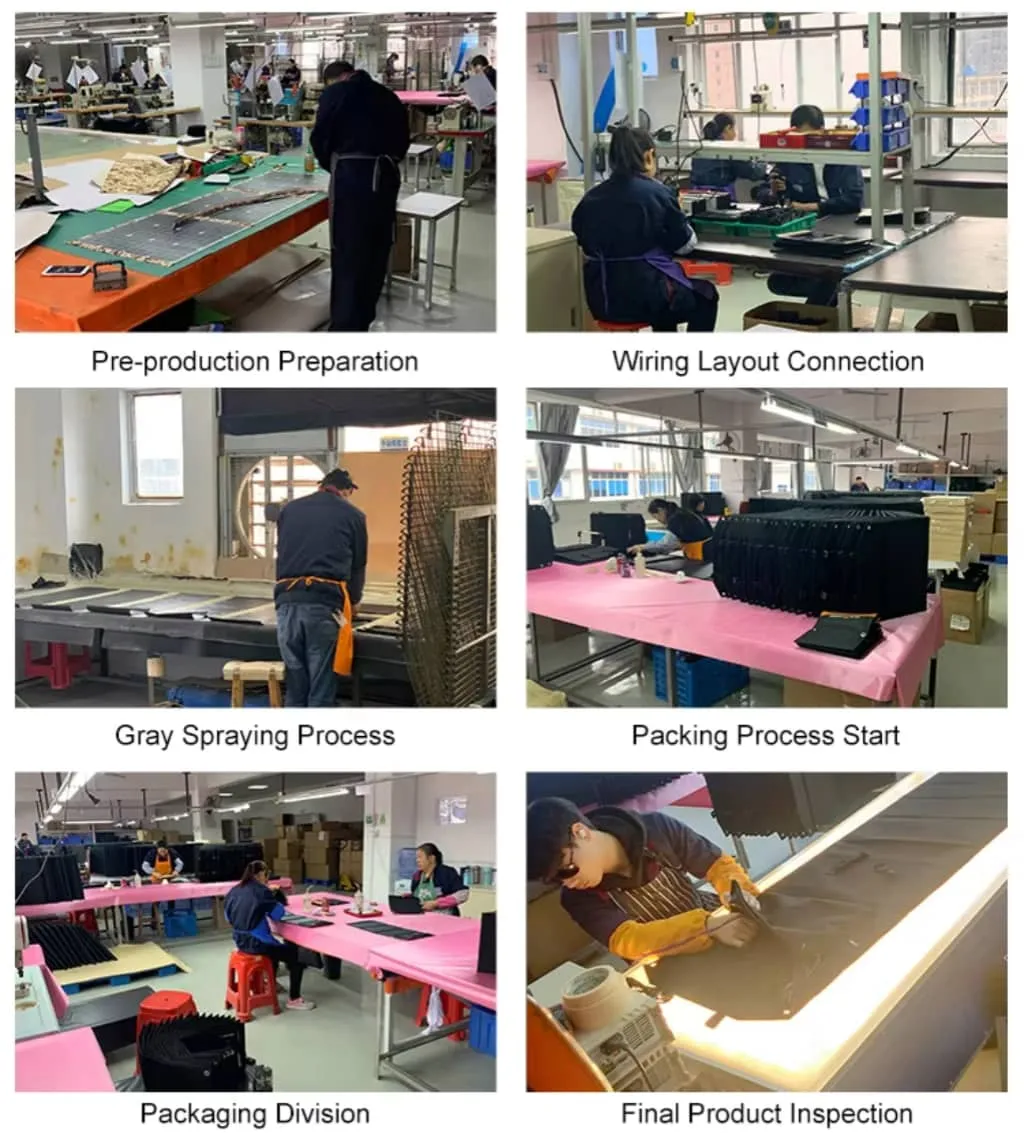
A factory flash test proves a panel works when it is new. Flexible and foldable panels fail later, after months of vibration, heat, bending and folding. Each of our tests copies one of those failures, and we send you the results with your samples.
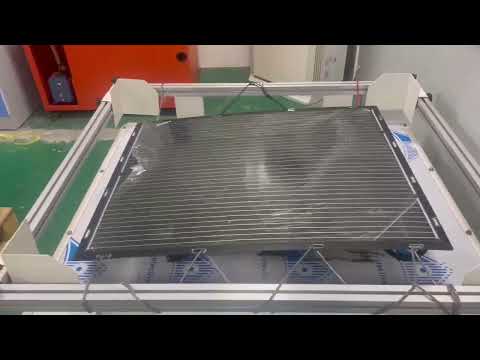
Watch the tests

What each test protects you from
| What goes wrong in real use | Why it matters to you | How we test | Result |
|---|---|---|---|
| Road vibration grows invisible cracks in the cells | Power drops months after delivery, and the warranty claim lands on your brand | Internal test: 24 hours of continuous vibration at 3.33 Hz, about 288,000 cycles | Under 1.5% power loss, no crack growth |
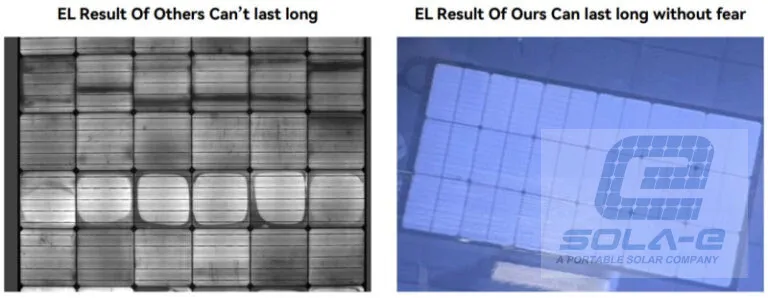
| Cracked cells look perfect at shipping | A cracked panel can still pass a power test, then fail in the field | EL imaging of every panel before shipment | EL images of samples on request; per-panel EL archive if your order requires it |
| Hinges wear out on foldable panels | Wiring and lamination at the fold break first, after a season of daily use | Repeated fold cycling | 50,000+ folds without power loss |
| Drops and knocks | One fall from a car trunk can crack cells or split a junction box | Drop testing of foldable panels | No structural damage |
| Over-bending on curved roofs | Bending past the limit cracks cells during installation | Bending tests to the stated limit for each size | Limit stated in writing on every spec |
| Heat and humidity break down materials | Films yellow and layers separate, cutting light and letting water in | 1,000 hours of damp heat at 85 °C / 85% RH (internal test), plus UV aging on materials | Power within 3% after DH1000 |
Why vibration comes first for RV panels
A rooftop panel on a house never moves. A panel on an RV is shaken for thousands of hours over its life. Stress concentrates at the weakest points of a cell, a micro-crack starts, and each trip makes it longer. Nothing is visible, and the panel still works, until the cracked section disconnects. That is why our RV panels use a structure that spreads stress across the panel, and why we run the vibration test before we call a panel an RV panel.
Why EL imaging is the test to ask every supplier for
Electroluminescence imaging passes current through the panel so the cells glow, and photographs the glow. Cracks show as dark lines. It is the only practical way to see micro-cracks, so a supplier who doesn’t EL-test every panel can’t know what they are shipping. Read more in what is EL testing.
Our six-step quality control
- Cell sorting. Cells are tested and grouped for consistent output.
- Automated lamination. Heat and pressure are controlled to prevent delamination.
- EL testing. Every panel is checked for micro-cracks. If your order requires it, we archive the EL image of every panel and send you the files.
- Visual and power inspection. Output is measured against the rated power.
- Aging tests. UV and environmental tests on materials and components.
- Final inspection. 100% outgoing inspection before dispatch.
What you receive
- EL images of your samples, and a per-panel EL archive for orders that require one.
- Vibration test data and bending and vibration test videos for project evaluation.
- QC reports for production orders from your account manager.
- Application limits and warranty terms in writing, agreed before production.
Third-party reports
| Test | Standard | Lab | Result | Report |
|---|---|---|---|---|
| IP67 on UT series folding panels (UT-15 to UT-400) | EN 60529 | Shenzhen STL Testing Technology Co., Ltd. | IP6X: 8 h dust chamber, pass. IPX7: 30 min at 1 m depth, pass | STL2023S0830284R-S1, Aug 2023 (PDF) |
Damp heat test (internal)
We ran small-format samples, built with the same structure and materials as our RV flexible panels, through 1,000 hours of damp heat at 85 °C and 85% relative humidity (DH1000, the “double 85” condition). Power after the test stayed within 3% of the starting value. This is an internal screening test, not a third-party certification.
Certifications
ISO 9001:2015 (Dongguan factory), BSCI, CE (EMC), RoHS and FCC. A factory audit report is available on request. Power tolerance is 0 to +3%: no panel ships below its rated power.
Tell us what you're building
We reply to B2B inquiries within 24 hours, with prices for your quantity and the models that fit your application.
- Emailinfo@sola-e.us
- Phone and WhatsApp+86 189 9893 8496
- FactoryTongyuan Science Park, No. 1 Qiaojiao Middle Road, Tangxia Town, Dongguan, China
- CatalogDownload the product catalog (PDF)