
Home / RV flexible solar panels
RV flexible solar panelsRated for the road
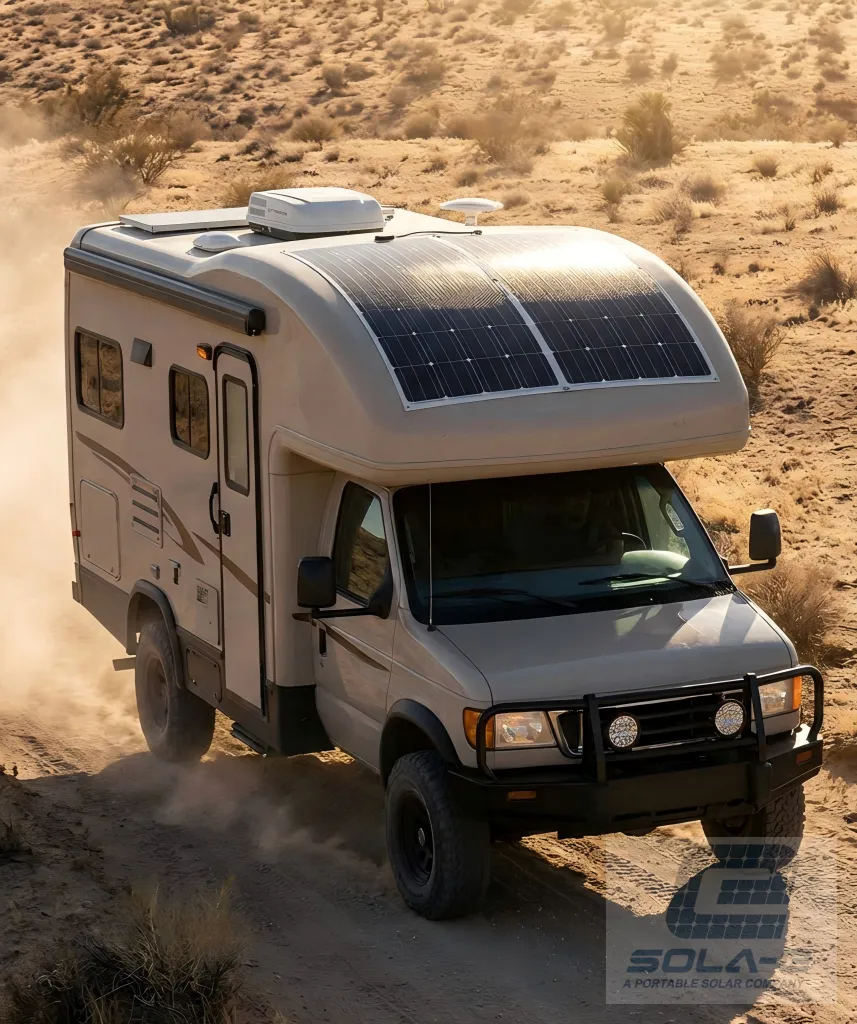
In our internal test, 288,000 vibration cycles cost under 1.5% of power. Made for RV roofs that never stay still.
At a glance
50–300 W HPBC panels, 2.6 mm thin, for curved camper and RV roofs.
- Power range
- 50–300 W, 8 models
- Weight
- 1–5.2 kg (2.1–11.4 lb)
- Cells
- HPBC, over 26% cell efficiency
- Thickness
- 2.6 mm (0.10 in)
- Bending
- Up to 360° on large panels (limit depends on size and power)
- Surface
- ETFE over EVA or POE encapsulation (chosen per project)
- Vibration test (internal)
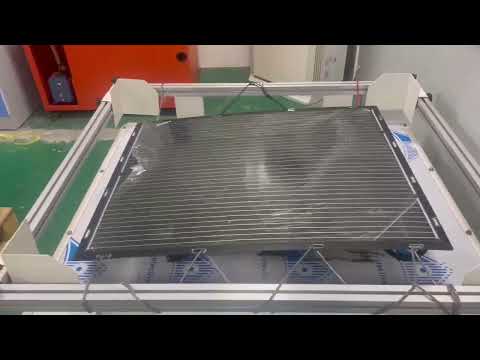
- 288,000 cycles, under 1.5% power loss
- Custom sizes
- 200 mm (7.9 in) wide to 2 m (6.6 ft) long
- Mounting
- With an air gap: ventilated backing sheet or rails. Not glued to the roof
- Warranty
- 3 years
- Minimum order
- 50 pcs per model
- Samples
- 7–10 days (10–15 days for custom sizes)
- Mass production
- 25–35 days after sample approval
- 288,000 vibration cycles in our internal test24 hours at 3.33 Hz, power loss under 1.5%, no crack growth. Run in our own lab, not by a third party.
- ETFE surface over EVA or POE encapsulationETFE resists UV and heat far better than PET. Encapsulant chosen per project and sealed by vacuum lamination.
- Fits curved and narrow roofs2.6 mm (0.10 in) thin. Larger panels bend up to 360°; the limit depends on size and power. Custom widths from 200 mm (7.9 in) and lengths up to 2 m (6.6 ft).
By application
Camper van conversions
Low-profile panels that fit between roof rails, fans and racks on converted vans.
Read moreTravel trailers and fifth wheels
Higher-wattage panels that cover larger roofs without adding glass weight.
Read moreTruck campers and overland rigs
Panels built for corrugated roads, branches and constant vibration.
Read moreRV manufacturers and rental fleets
Locked specifications, QC reports and written limits for factory-fit solar.
Read moreGolf carts and low-speed vehicles
Standard flexible panels plus a boost MPPT controller for 36 V and 48 V carts, for cart makers and accessory brands.
Read moreHow many watts does your RV need?
Add your loads and roof size. Get panel layouts, controller and battery sizes.
Models and specifications
HPBC cells over 26% efficiency, ETFE surface, 2.6 mm (0.10 in) thick, 3-year warranty.
| Model | Power | Vmp / Imp | Voc / Isc | Size | Weight |
|---|---|---|---|---|---|
| USF-50H | 50 W | 20 V / 2.5 A | 25 V / 2.66 A | 640 × 400 mm25.2 × 15.7 in | 0.96 kg2.1 lb |
| USF-100H | 100 W | 20 V / 5 A | 25 V / 5.32 A | 840 × 580 mm33.1 × 22.8 in | 1.82 kg4.0 lb |
| USF-115H | 115 W | 18 V / 6.4 A | 22.5 V / 6.8 A | 990 × 580 mm39.0 × 22.8 in | 2.14 kg4.7 lb |
| USF-150H | 150 W | 20 V / 7.5 A | 25 V / 7.98 A | 1220 × 580 mm48.0 × 22.8 in | 2.64 kg5.8 lb |
| USF-200H | 200 W | 20 V / 10 A | 25 V / 10.6 A | 1220 × 770 mm48.0 × 30.3 in | 3.51 kg7.7 lb |
| USF-220H | 220 W | 30 V / 7.33 A | 35 V / 7.55 A | 1555 × 690 mm61.2 × 27.2 in | about 4.0 kg |
| USF-250H | 250 W | 18 V / 13.9 A | 22.5 V / 14.8 A | 1540 × 770 mm60.6 × 30.3 in | 4.43 kg9.8 lb |
| USF-300H | 300 W | 20 V / 15 A | 25 V / 16 A | 1800 × 770 mm70.9 × 30.3 in | 5.18 kg11.4 lb |
USF-220H has 7 bypass diodes for roofs with partial shade from air conditioners, vents or racks. Optional PWM or MPPT controllers (10 A / 20 A), pre-tested with your panels and shipped as one kit.
Watch the tests

Which panel for which vehicle
| Vehicle | Typical solar | Models to start with | What to watch |
|---|---|---|---|
| Camper van | 200–400 W | USF-100H, USF-150H, USF-200H | Roof fan and rack shadows, ribbed roof |
| Travel trailer, fifth wheel | 600–1,000 W | USF-200H, USF-250H, USF-300H | Air conditioner shade, long cable runs, walkway |
| Truck camper, overland rig | 200–400 W | USF-115H, USF-150H, USF-200H | Constant vibration, branches, pop-top hinge lines |
| Factory fit, rental fleet | Set per model line | One or two sizes, or a custom size | Consistency, written limits, spare panels |
Work out your own numbers with the RV solar calculator.
Buyer’s checklist
Ask any flexible panel supplier these questions before you order:
- What are the front film and the encapsulant?
- Do you have vibration test data, with EL images before and after?
- How many bypass diodes does the panel have, and how does it behave in partial shade?
- How should the panel be mounted, and does it need an air gap?
- What is the bending limit?
- What does the warranty cover, in writing?
- Can you send EL images of my samples?
- Can you match the panel voltage to my controller and battery?
Built for RV brands, upfitters and fleets
We supply RV and camper manufacturers, upfitters, fleet operators and solar kit brands. Tell us your roof size, target wattage and order volume, and we’ll recommend a configuration and send the test data that goes with it.
What we can customize
- Size and shape. Widths from 200 mm (7.9 in), lengths up to 2 m (6.6 ft), made to size at the factory for curved roofs and tight spaces.
- Electrical. Voltage and current matched to your controller and battery system.
- Connectors and cables. MC4, Anderson and other connectors, with cable lengths to suit your roof layout.
- Kits. PWM or MPPT controllers (10 A / 20 A) pre-tested with the panels.
- Branding. Your logo on the panel and your packaging.
How we pack for export
Flexible panels ship in fully enclosed plywood crates (ISPM 15 compliant), which keep stacking loads off the panels. Loading is planned for 20GP and 40HQ containers. Because there is no glass, you fit about 30% more power in each container than with rigid panels.
Questions buyers ask
How are the panels installed on an RV roof?
On a ventilated backing sheet, such as twin-wall polycarbonate, or on rails, fixed through the panel's eyelets. Leave an air gap behind the panel and stay within the bending limit for its size.
Can I glue the panel directly to the roof?
We don't recommend it. A panel glued flat to the roof has no air behind it and can't shed heat. It loses power, ages faster, and in hot weather a shaded cell is more likely to become a hot spot. Mount it with an air gap instead.
Can I connect the panels to my RV battery?
Yes, through a charge controller, with 12 V to 48 V battery systems. Panels can be linked to add power.
What is the narrowest or longest panel you can make?
Custom widths start at 200 mm (7.9 in), and we make seamless panels up to 2,000 mm (6.6 ft) long.
What is the MOQ and warranty?
50 pieces per model, with a 3-year warranty against material and workmanship defects.
How long do flexible RV panels last?
With an ETFE surface over EVA or POE encapsulation, sealed by vacuum lamination, our panels are built for 10 years or more of outdoor use. They carry a 3-year warranty against material and workmanship defects.
Can I walk on the panels?
No. Avoid standing on any flexible panel; point loads crack cells. Leave a walkway between panels for roof maintenance.
What cells do you use?
HPBC back-contact monocrystalline cells over 26% efficiency, with no front busbars, which gives a full-black look.
Can your panels charge a 48 V battery?
Yes. Instead of raising the panel voltage, we recommend a boost or buck-boost MPPT controller, which keeps charging when heat or shade pulls the panel voltage below the battery voltage.
Do you supply charge controllers?
Yes. PWM controllers for small 12 V kits and MPPT controllers (10 A and 20 A) for panels over 100 W, pre-tested with our panels.
Related guides
November 22, 2026How much solar power does an RV get in winter?
A 400 W flat roof array makes roughly 1 kWh a day in a southern Arizona December, and under half that in the northern states. Why winter output drops, and how to get more.
November 13, 2026Field case: a 5 cm shadow cut a panel to 30% of its power
A real customer case. Why a small shadow next to an air conditioner crippled a flexible panel, why the 48 V battery stopped charging, and how we are fixing it.
November 13, 2026Flexible vs rigid solar panels for RVs: which should you choose?
Weight, height, durability, heat and cost compared. When flexible panels beat rigid glass panels on an RV, and when they don't.
Our other product lines
Foldable solar panels 100–400 W
100–400 W panels for power stations and off-grid kits. IP67 laminated or IP54 fabric.
Foldable solar chargers 15–80 W
Fold-up chargers with USB-C PD and QC3.0 for phones, power banks and small power stations.
Balcony flexible solar panels
135–230 W glass-free panels that tie onto railings and plug into a micro-inverter.
Tell us what you're building
We reply to B2B inquiries within 24 hours, with prices for your quantity and the models that fit your application.
- Emailinfo@sola-e.us
- Phone and WhatsApp+86 189 9893 8496
- FactoryTongyuan Science Park, No. 1 Qiaojiao Middle Road, Tangxia Town, Dongguan, China
- CatalogDownload the product catalog (PDF)