
How much solar power does an RV get in winter?
A 400 W flat roof array makes roughly 1 kWh a day in a southern Arizona December, and under half that in the northern states. Why winter output drops, and how to get more.
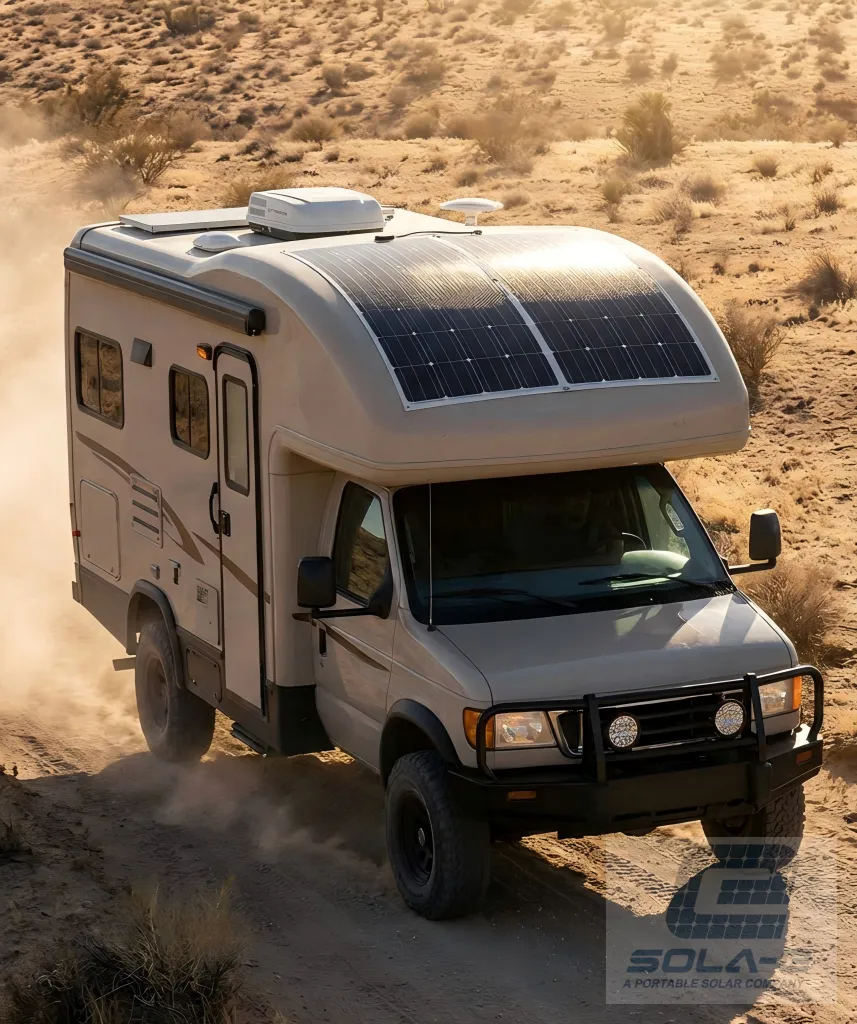
Short answer: in December, a 400 W array mounted flat on an RV roof makes roughly 1 kWh a day in southern Arizona and about 0.3–0.5 kWh in the northern states. That is often a third to a half of what the same roof makes in summer. Short days, a low sun and the flat roof all cut output. Cold weather actually helps the panels a little.
Why winter output drops
Shorter days and weaker sun. December brings fewer daylight hours, and the low sun passes through more atmosphere. NREL-based estimates put December at about 5 peak sun hours in Phoenix, 2.5 in Minneapolis and 1.5 in Seattle (eLEDLights, from NREL data).
| City | December peak sun hours |
|---|---|
| Phoenix, AZ | about 5.0 |
| Los Angeles, CA | about 4.2 |
| Atlanta, GA | about 3.8 |
| Chicago, IL | about 2.8 |
| Minneapolis, MN | about 2.5 |
| Seattle, WA | about 1.5 |
A flat roof faces the wrong way. RV panels lie flat, which suits the high summer sun. On December 21 at noon, the sun is only about 33° above the horizon in Phoenix and 22° in Minneapolis. A flat panel then catches roughly 55% and 37% of the direct light that a panel facing the sun would. Across a whole day, a flat panel can collect 30–50% less in December than one tilted toward the sun.
Snow and shade. Snow blocks light completely. Low winter sun also casts long shadows from trees, buildings and the RV’s own roof equipment, which cuts output sharply (see why partial shade matters).
Cold is the good news. Panels produce more when they are cool. Our HPBC panels lose 0.283% per °C above 25 °C, so a cool winter panel stays close to its rating, while a summer roof at 65 °C loses about 11%.
What a 400 W roof makes in December
A rough estimate for a flat roof array:
Daily energy ≈ rated watts × December peak sun hours × flat-roof factor × 0.8
The flat-roof factor is about 0.65 in the southern states and 0.55 further north. The 0.8 covers wiring, controller and battery losses, a little better than summer because the panels run cool.
| Location | Estimate for 400 W, flat |
|---|---|
| Southern Arizona | about 1.0 kWh per day |
| Atlanta | about 0.8 kWh per day |
| Minneapolis | about 0.4 kWh per day |
| Seattle | about 0.3 kWh per day |
Rough planning figures. Cloudy weeks can be far lower, clear desert days higher. For your own route, use NREL’s free PVWatts calculator with a 0° tilt.
How to get more from winter sun
Head south. It is the single biggest factor, and the reason snowbirds favor Arizona, southern California, Texas and Florida.
Add a foldable panel you can aim. A portable panel propped up facing the sun can collect far more in winter than the same watts lying flat on the roof, and it can sit in the sun while the RV is parked in shade. A 200 W foldable such as our UT200H weighs 5.3 kg (11.7 lb) and plugs into most RV charge controllers or power stations with the right cable.
Tilt rigid panels if you stay put. RVers who tilt rigid panels report around 40% more in winter (Gone with the Wynns), but it means climbing on the roof at each stop. Flexible panels bonded to the roof can’t tilt, which is the trade-off for their low weight and low profile.
Use the roof space. Winter is when roof area matters most. Higher-efficiency HPBC cells fit more watts into the same space; see HPBC vs PERC.
Clear snow gently. Use a soft brush or a foam snow rake. Don’t scrape the surface with ice scrapers or shovels, which can scratch the ETFE film.
Check the controller’s voltage limit. Cold raises panel voltage. A string that sits just under the controller’s limit in summer can exceed it on a frosty morning. Our voltage headroom guide shows how to check.
Protect the battery. Most lithium (LiFePO4) batteries must not be charged below 0 °C (32 °F) unless they have built-in heating. Check that the battery or charge controller blocks charging in freezing weather.
For RV builders and dealers
Customers who travel in winter judge a solar package by its December output, not its summer peak. Show winter estimates alongside summer ones, make sure the roof layout leaves no panel in the shadow of the AC unit or vents, and consider offering a foldable panel as a winter add-on.
We make flexible RV panels from 50 to 300 W and foldable panels from 100 to 400 W, under your brand from 50 pieces per model. Try our RV solar calculator or see the RV flexible panel range.
FAQ
Do solar panels work in winter? Yes. They work well in cold, clear weather. Output falls because days are short and the sun is low, not because of the cold.
Is 400 W of solar enough for winter RV camping? In the southern states, on sunny days, it usually covers lights, device charging and a fridge running on propane. A furnace fan running all night can use much of a day’s output. In the northern states, expect to need a generator, shore power or more panels during cloudy spells.
Should I remove snow from RV solar panels? Yes, gently, with a soft brush. A thin layer blocks most of the light.
Why does my controller show high voltage on cold mornings? Panel voltage rises as the temperature drops. That is normal, but check it stays below your controller’s maximum input voltage.