
Flexible vs rigid solar panels for RVs: which should you choose?
Weight, height, durability, heat and cost compared. When flexible panels beat rigid glass panels on an RV, and when they don't.
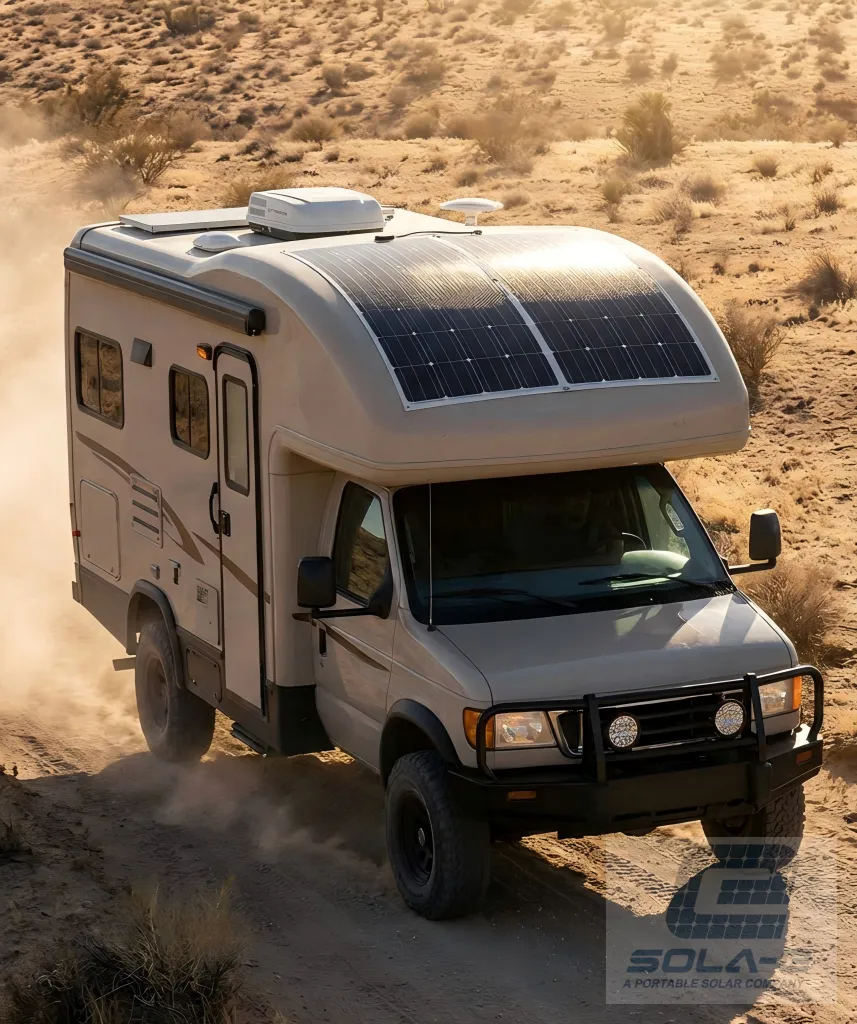
Short answer: choose flexible panels when weight, roof height, curved roofs or aerodynamics matter, which covers most vans, campers and trailers. Choose rigid glass panels when roof space is plentiful, weight doesn’t matter, and you want the lowest cost per watt.
Side by side
| Flexible (ETFE, on a ventilated backing) | Rigid (glass, framed) | |
|---|---|---|
| Weight for 200 W | About 3.5 kg (7.7 lb) plus a light backing sheet, no rack | Typically several times more, plus brackets |
| Height on roof | 2.6 mm (0.10 in) panel plus a thin vented sheet | Frame plus mounting brackets |
| Curved roofs | Follows curved roofs; larger panels bend up to 360° | Needs a flat area or a rack |
| Roof holes | None if the backing sheet is taped or bonded to the roof | Usually several per panel |
| Cooling | Air channels in the backing sheet | Air gap under the panel |
| Wind noise and drag | Minimal | Can hum and add drag |
| Cost per watt | Higher | Lower |
Where flexible panels win
- Vans and small campers, where roofs are curved and short, and every millimeter of height counts.
- Payload-limited trailers, where saving weight leaves room for water and gear.
- Fiberglass and aluminum roofs that owners don’t want to drill.
- Stealth or low-profile builds, where panels shouldn’t be visible from the street.
Where rigid panels still make sense
- Large, flat roofs with plenty of space, where weight and height don’t matter.
- Roofs where no air gap is possible. A flexible panel should never be glued straight onto the roof skin in a hot climate.
- The lowest possible cost per watt, for budget builds.
The durability question
Early flexible panels earned a poor reputation: thin PET surfaces that yellowed, edges that let moisture in, and cells that cracked on the road. Modern flexible panels close most of that gap if they use:
- an ETFE surface instead of PET,
- a well-made encapsulant (EVA or POE) and full vacuum lamination,
- a structure that spreads vibration stress, and
- EL imaging to catch micro-cracks before shipping.
Our USF panels use all four, and were run through 24 hours of continuous vibration in our internal test (about 288,000 cycles) with under 1.5% power loss. Read why flexible panels fail on RVs for the details.
Managing heat
We don’t recommend gluing a flexible panel directly to the roof. With no air behind it, the panel can’t shed heat: power drops, and in today’s hotter summers a shaded or dirty cell is more likely to turn into a hot spot. Mount the panel on a ventilated backing sheet, such as twin-wall polycarbonate, so air moves behind it, and pair it with an MPPT controller.
Bottom line
For most RVs, the weight, height and no-drill advantages of a well-built flexible panel outweigh the higher cost per watt. Use our RV solar calculator to see which panels fit your roof.