
Why flexible solar panels fail on RVs, and how we test for it
Vibration, heat and bending cause micro-cracks and delamination in flexible RV panels. Here is how the damage starts, and the tests that catch it.
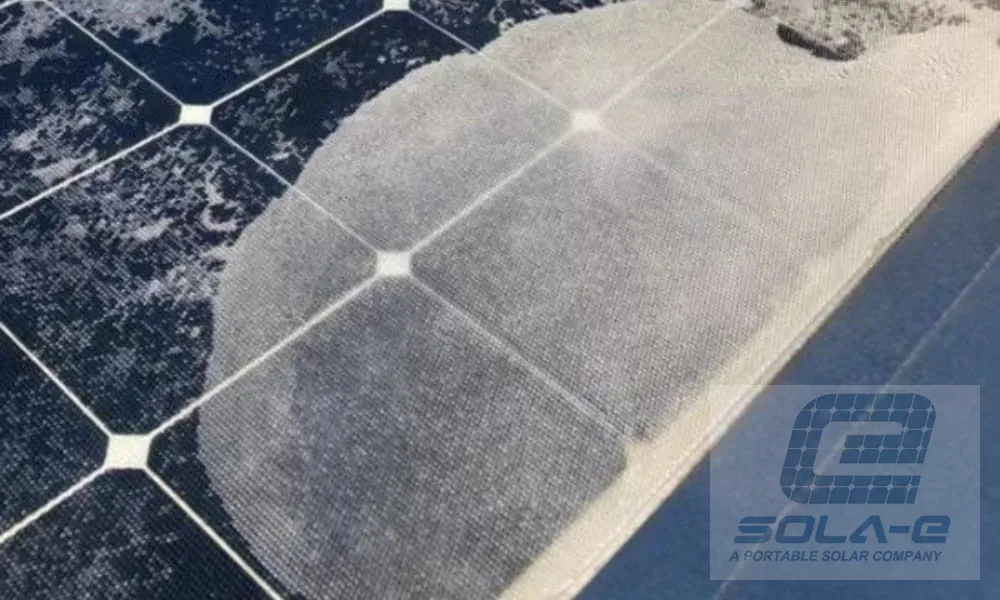
Most flexible panels don’t fail on day one. They pass the factory test, then lose power over months on a moving roof. For an RV brand or upfitter, that shows up as warranty claims a year later.
How the damage starts
Vibration. Every mile on the road flexes the panel slightly. Road vibration is strongest at low frequencies, where a poorly supported panel can resonate (how road vibration cracks panels). If the stress concentrates at weak points, micro-cracks start in the cells and slowly grow.
Heat. A flexible panel glued flat to a roof has no air behind it and can’t shed heat. Shaded or dirty cells can then overheat into hot spots. Heat and UV break down cheaper PET surfaces and EVA encapsulation, which leads to yellowing and delamination.
Bending. Fitting a panel to a curved roof is fine within its limit. Bending it further, or repeatedly, cracks cells.
What we do about it
- Spread the stress. Our USF panels use a structure that spreads load across the panel instead of concentrating it at weak points.
- Better materials. An ETFE surface over EVA or POE encapsulation, sealed by vacuum lamination. ETFE resists UV and heat far better than PET.
- Clear limits. We state the bending limit for each model in writing and tell partners where a panel should not be used.
How we test
- 24-hour vibration test (internal). Run in our own lab at 3.33 Hz, about 288,000 cycles. Power dropped by less than 1.5%, with no crack growth.
- EL imaging of every panel. Electroluminescence imaging shows micro-cracks invisible to the eye. EL images of samples are available on request.
Installation tips for RV roofs
- Don’t glue the panel straight onto the roof. Mount it on a ventilated backing sheet, such as twin-wall polycarbonate, so air can move behind it.
- Don’t bend the panel past the stated limit for its size.
- Use a charge controller matched to the panel, and an MPPT controller for panels over 100 W.
Questions to ask any supplier
- Do you have vibration test data, not just a datasheet?
- How is stress spread when the panel bends?
- What happens after thermal cycling?
- Will degradation show up before power drops, and how do you check?