
How road vibration cracks solar panels on RVs
Road vibration is concentrated at low frequencies. When it matches a panel's own resonance, the panel flexes far more and micro-cracks grow. How it happens and how to prevent it.
Short answer: a moving vehicle shakes its roof mostly at low frequencies, from about 1 Hz up to around 20 Hz. If a solar panel’s own natural frequency falls in that band, typically 5–15 Hz for a loosely supported flexible panel, it resonates: the panel flexes many times harder than the roof moves. Each flex strains the silicon cells, and over thousands of miles micro-cracks start and grow until power drops.
Where the vibration comes from
| Source | Typical frequency |
|---|---|
| Body bouncing on the suspension | About 1–3 Hz |
| Wheels and axles hopping on rough roads | About 10–15 Hz |
| Corrugated (washboard) tracks | Varies with speed, often 5–20 Hz |
| Engine and driveline | Higher, usually above 20 Hz |
Typical values for road vehicles. Each vehicle and road is different.
Most of the energy that reaches the roof sits in the low band. A panel on a house roof never sees any of it.
Why resonance is the real danger
Every object has a natural frequency at which it “wants” to vibrate. Push a swing at just the right rhythm and it goes higher each time. A solar panel behaves the same way.
A thin flexible panel that is only held at its corners, or that spans a gap, has a low natural frequency, often in the 5–15 Hz range. That is exactly where road vibration is strongest. When the two match, a few millimeters of roof movement can become a much larger wave across the panel, again and again, for hours.
What it does to the cells
Silicon cells are thin and brittle, a fraction of a millimeter thick. They tolerate a gentle curve, but not repeated flexing.
- Stress concentrates at weak points: cell edges, solder joints, the gaps between cells.
- A micro-crack starts. It is invisible, and the panel still works.
- Every trip extends the crack.
- Eventually a section of the cell is cut off electrically. Power falls, and the isolated area can overheat into a hot spot.
This is why vibration failures show up months after delivery, not at the factory.
How to prevent it
In the panel
- A structure that spreads stress across the panel instead of letting it concentrate at weak points.
- An ETFE surface over EVA or POE encapsulation, laminated to hold the cells firmly.
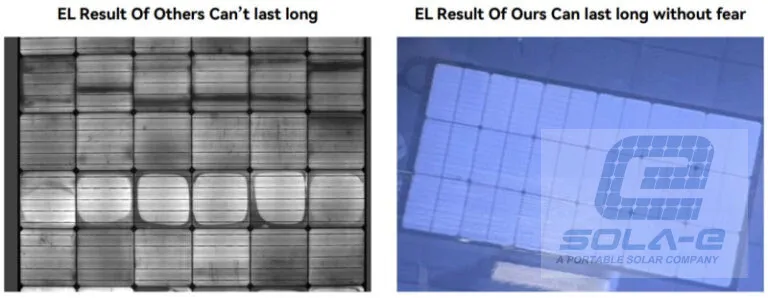
- EL imaging of every panel, so no panel ships with a crack already started.
In the installation
- Support the whole panel, not just its corners. An unsupported span is what lowers the natural frequency into the danger band.
- Use a ventilated backing sheet: it supports the panel across its full area and adds damping, while keeping air moving behind it.
- Fix every eyelet, and leave no edge free to flap.
How we test
In our own lab, we run our flexible panels through 24 hours of continuous vibration at 3.33 Hz, about 288,000 cycles. Power loss was under 1.5%, with no crack growth in EL images taken before and after. Watch the vibration test and see how we test.
Questions to ask any supplier
- Do you have vibration test data, with EL images before and after?
- At what frequency, and for how long?
- How should the panel be supported so that it can’t resonate?