
What is EL testing, and why should you ask for it?
EL imaging reveals micro-cracks that are invisible in a solar panel. What it shows, how to read it, and why buyers should ask for EL reports.
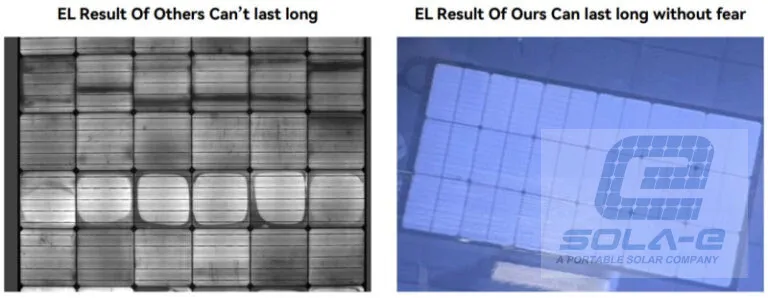
Short answer: EL (electroluminescence) testing passes current through a solar panel so the cells glow faintly in near-infrared light, then photographs the glow. Cracks, broken connections and dead cell areas show up as dark lines and patches. It is the only practical way to find micro-cracks before a panel ships, so buyers should ask for EL images of their samples.
Why micro-cracks matter
A micro-crack doesn’t change how a panel looks, and it may not change the power reading on day one. But cracks grow with vibration, bending and temperature swings. Over months, the cracked area disconnects and power drops. Flexible and foldable panels, which bend and vibrate in use, are especially exposed.
What an EL image shows
- Uniform glow: healthy cells.
- Dark lines: cracks across a cell.
- Dark patches or segments: areas cut off by cracks or broken fingers.
- Fully dark cells: dead or disconnected cells.
When EL testing happens
Good factories EL-test at more than one stage: after stringing the cells, and again on the finished panel before shipping. We EL-image every panel before it leaves the factory.
What to ask a supplier
- Do you EL-test every panel, or only samples?
- Will my samples ship with their EL images?
- Can you EL-test samples again after your vibration or bending test, so I can see how the panel holds up?
How we use it
Every Sola-E panel is EL-imaged before shipment. We send EL images of your samples on request, and can archive the EL image of every panel in your order if you ask for it. In our own lab we combine EL with a 24-hour vibration test, bending tests and fold testing to show how our panels behave after stress, not just on day one. See how we test.