
Case: a 19 V panel instead of a high-voltage one for a 48 V vehicle
A vehicle maker asked for a custom high-voltage 100 W solar panel. We supplied a standard 19 V flexible panel and a 300 W boost controller instead. They reordered for years.
Short answer: a maker of a solar-canopy electric vehicle asked us for a custom high-voltage 100 W panel to charge a 48 V battery through a PWM controller. After going through their system with them, we recommended a standard 19 V, 100 W flexible panel with a 300 W boost MPPT controller. It worked well, and they reordered for several years.
The customer’s name is withheld.
What the customer asked for
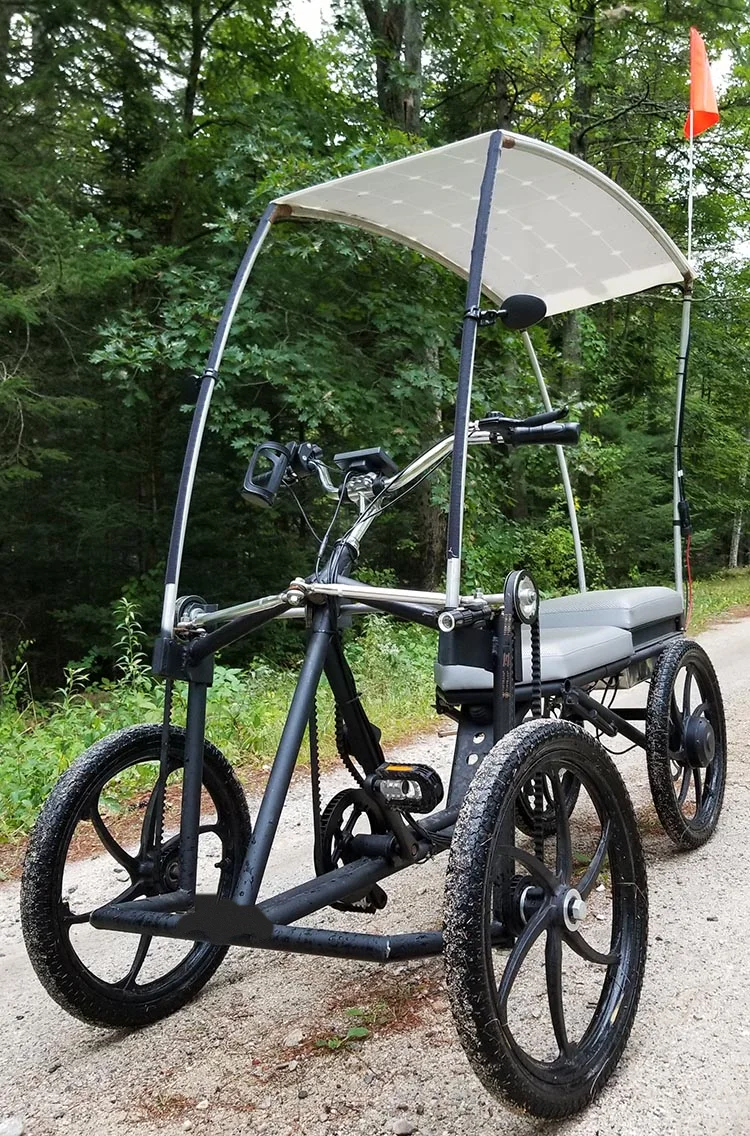
The customer built a four-wheeled, pedal-assist electric vehicle with a curved roof canopy. They wanted the canopy to be a solar panel that charges the vehicle’s removable 48 V lithium battery.
Their first request was a single 100 W panel with a very high output voltage. The reason was their charge controller: they planned to use a PWM controller, and a PWM controller can only charge when the panel voltage is higher than the battery voltage.
Why we advised against it
A 48 V lithium pack charges to about 54.6 V. A 100 W panel built to stay above that voltage would have had several problems on this vehicle:
- Very low current, very long string. 100 W at around 60 V is under 2 A. To reach that voltage, the panel needs a long chain of small cut cells in series.
- Higher hot-spot risk. When one cell in a long series string is shaded, all the other cells push against it, and it heats up. The longer the string, the harder they push. A canopy is shaded all the time by trees, buildings and the rider.
- Wasted power with PWM. A PWM controller pulls the panel down to battery voltage and throws away the rest. It can’t track the panel’s best operating point.
- No margin in heat. Panel voltage falls as cells warm up, so on hot days the panel could drop below the battery voltage and stop charging.
- A one-off design. A custom high-voltage panel costs more, takes longer, and is harder to replace.
What we supplied instead
| Part | Specification |
|---|---|
| Panel | Flexible, 100 W, about 19 V working voltage, curved to the canopy |
| Controller | Boost MPPT, 300 W, set for the 48 V battery |
The panel stays at a standard voltage, and the controller raises it to the battery’s charging voltage. In shade or heat, the panel voltage can move without ever falling “too low”, because the controller is built to boost from a low input.
The result
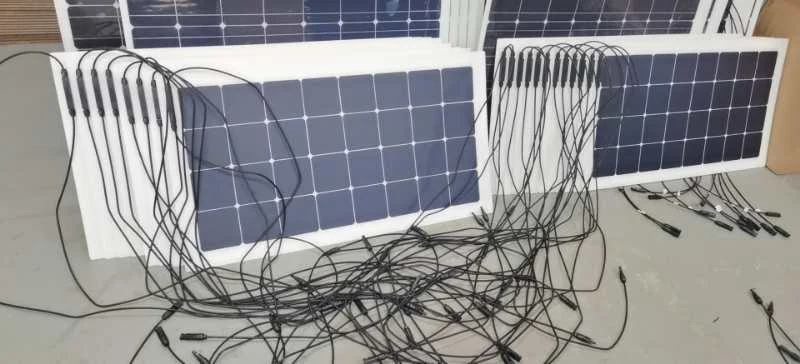
The system charged the vehicle’s battery from the canopy, parked or moving, and the customer has reordered for several years. Over time they added 50 W and 140 W panels at the same standard voltage to fit different roofs, all working with the same type of boost controller.
What to take from this
- Start from the battery and how the vehicle is used, not from a target panel voltage.
- Don’t pair a PWM controller with a battery above 24 V unless the panel voltage is well matched. An MPPT boost controller is the safer choice.
- For 36 V to 72 V batteries and small panel areas, a standard panel with a boost controller is usually simpler, cheaper and more shade-tolerant than a high-voltage panel.
- Tell your supplier the battery voltage, chemistry and charging limits before asking for a panel.
Building golf carts or other low-speed vehicles? See solar roofs for golf carts. See also our e-bike and electric vehicle charging kits and charging 36 V and 48 V batteries from standard panels.