
Home / Foldable solar panels 100–400 W / E-bike and electric off-road vehicle charging
Solar charging kits for e-bikes and electric off-road vehicles
A foldable panel can't charge an e-bike battery on its own, because the battery voltage is higher than the panel's. We pair the panel with a boost MPPT controller, pre-set for your battery, and fit the charging plug your vehicles use.
At a glance
Foldable panel plus boost controller kits for 24 V to 72 V batteries, for brands, dealers and fleets.
- Power range
- 100–200 W, 4 models
- Weight
- 2.4–5.3 kg (5.3–11.7 lb)
- Recommended models
- UT100H, UT200H, UC100W, UC200W
- Builds
- IP67 laminated (UT) or IP54 fabric (UB, UC)
- Outputs
- DC up to 40 V, USB-C PD up to 60 W, MC4 on 300–400 W
- Warranty
- 3 years (IP67), 1 year (IP54)
- Minimum order
- 50 pcs per model
- Samples
- 7–10 days (10–15 days for custom sizes)
- Mass production
- 25–35 days after sample approval
What this application demands
- Battery voltage is higher than the panel'sA 48 V e-bike pack charges to about 54.6 V. A standard foldable panel works at around 18–20 V. The controller has to boost it.
- Every brand uses a different plugDC5521 barrel plugs, three-pin aviation connectors and others. The wrong plug, or the wrong polarity, means returns.
- Lithium charging must be set correctlyThe controller's charge voltage has to match the pack exactly. A wrong setting can damage the battery.
Panels for e-bike charging kits
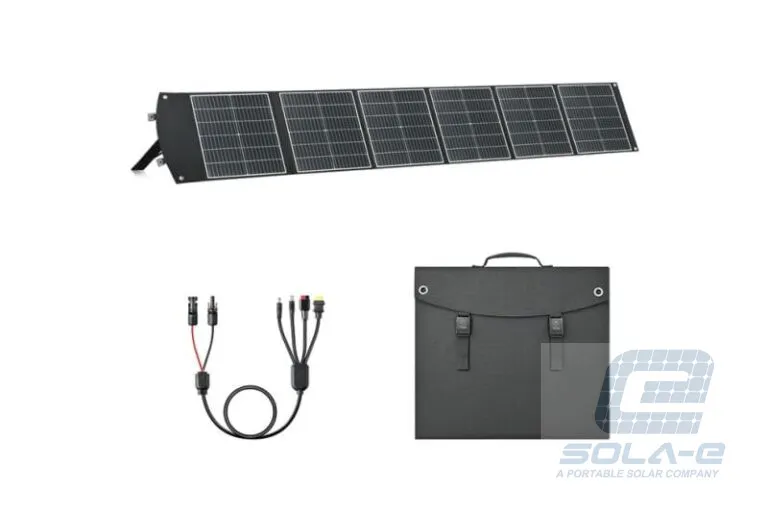
100–200 W suits most e-bike batteries, and the controllers accept up to 300 W or 600 W of panel. IP67 laminated panels handle trail and all-weather use. IP54 fabric panels suit lower-cost kits. Each kit ships with a boost MPPT controller for 24 V to 72 V batteries.
| Model | Type | Power | Vmp / Imp | Voc / Isc | Open size | Folded | Weight | Outputs |
|---|---|---|---|---|---|---|---|---|
| UT100H | IP67 laminated | 100 W | 20.5 V / 4.88 A | 25.6 V / 5.42 A | 1409 × 396 mm55.5 × 15.6 in | 396 × 390 mm15.6 × 15.4 in | 2.4 kg5.3 lb | DC 20.5 V / 4.88 A, USB-A 24 W, PD 60 W |
| UT200H | IP67 laminated | 200 W | 20.5 V / 9.76 A | 25.6 V / 10.83 A | 1739 × 602 mm68.5 × 23.7 in | 602 × 473 mm23.7 × 18.6 in | 5.3 kg11.7 lb | DC 20.5 V / 9.76 A, USB-A 24 W, PD 60 W |
| UC100W | IP54 fabric | 100 W | — | — | 1715 × 400 mm67.5 × 15.7 in | 400 × 265 mm15.7 × 10.4 in | 2.7 kg6.0 lb | DC 20 V / 5 A, USB-A 24 W, PD 45 W |
| UC200W | IP54 fabric | 200 W | — | — | 2650 × 460 mm104.3 × 18.1 in | 460 × 415 mm18.1 × 16.3 in | 4.8 kg10.6 lb | DC 20 V / 10 A, USB-A 24 W, PD 45 W |
Who this is for
- E-bike and electric off-road vehicle brands adding a solar charging accessory to their range.
- Dealers and accessory brands selling to riders who camp, hunt or travel off-grid.
- Rental fleets and tour operators charging bikes where there is no grid.
We don’t sell single kits to riders. Minimum order is 50 kits per model.
What’s in a kit
- A foldable panel, 100–200 W, in an IP67 laminated or IP54 fabric build.
- A boost MPPT controller for 24 V, 36 V, 48 V, 60 V or 72 V batteries.
- A charging cable with your plug, such as DC5521 or a three-pin aviation connector.
- Your branding on the panel and the controller label, plus packaging and instructions.
Boost MPPT controller
| 300 W model | 600 W model | |
|---|---|---|
| Maximum solar input | 300 W | 600 W |
| Battery voltage | 24 V, 36 V, 48 V, 60 V or 72 V, or user-set | Same |
| Panel input voltage | 12–50 V, and always below the battery voltage | Same |
| Charging mode | MPPT, boost | MPPT, boost |
| Charge settings | Pre-set at the factory to your battery, or set by you with our guide | Same |
A boost controller only works when the panel voltage is lower than the battery voltage. If your panel voltage could rise above it, ask us about a buck-boost controller instead.
Private-label controllers
We supply the controller under your brand, with your logo, wiring diagram and voltage ratings printed on the label. We have done this for a US off-road electric bike brand, whose riders use it to charge in the backcountry, far from any outlet. A US e-bike retailer orders a smaller kit from us: a 120 W panel with the 300 W controller.
Panels mounted on the vehicle
The same approach works with a panel fixed to the vehicle. A maker of a four-wheeled, pedal-assist electric vehicle asked us for a custom high-voltage 100 W panel for its curved roof canopy. We supplied a standard 19 V, 100 W flexible panel and a 300 W boost controller for its 48 V battery instead. It worked well, and they reordered for years. Read the case.
A flexible panel suits a canopy, cargo box or trailer lid, because it follows the curve and adds little weight.
Typical full-charge voltages
| Nominal battery | Typical lithium-ion full-charge voltage |
|---|---|
| 36 V (10S) | 42.0 V |
| 48 V (13S) | 54.6 V |
| 60 V (16S) | 67.2 V |
| 72 V (20S) | 84.0 V |
Typical values for lithium-ion (NMC) packs. Other chemistries and cell counts differ. Always use the battery maker’s specification.
When the plug doesn’t fit
Charging plugs are the most common snag. One customer’s e-bike used a connector that didn’t match the cable supplied. We tracked down the matching connector and sent it, and the kit worked. His review afterwards, translated from German: “Here again, thanks to Sam, problem solved!” (M. Peschke). This is why we ask for a sample or drawing of your plug before production.
What we need from you
- Battery voltage, chemistry and capacity, and the maker’s charging specification
- The charging plug type and polarity, ideally with a sample or drawing
- Where and how riders will use the kit
Safety
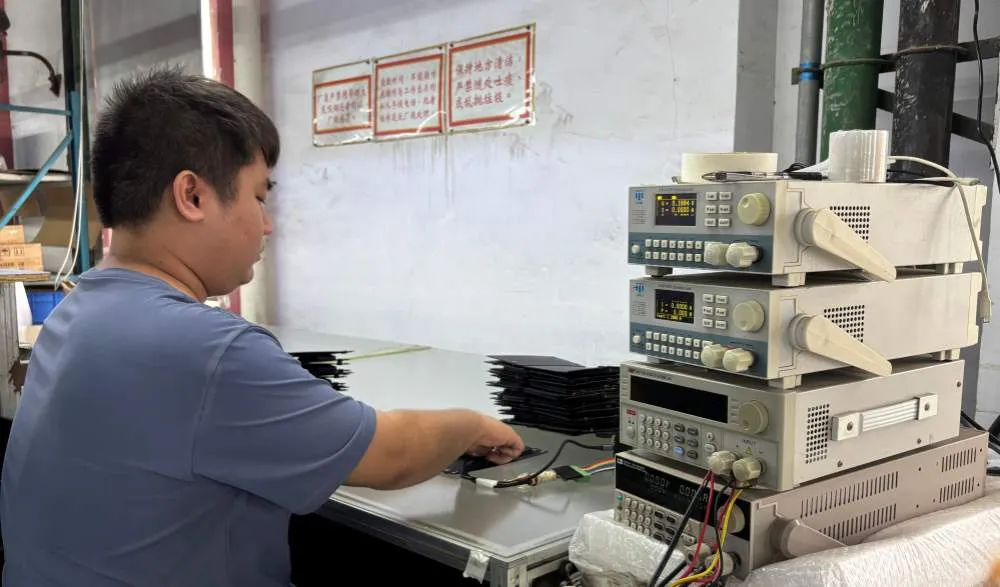
Solar charging connects to a lithium battery, so the details matter. We confirm the charge voltage and plug polarity with you in writing before production, and test each panel and controller pairing before shipping. The battery’s own management system (BMS) must remain in the charging path.
Why a boost controller, not a high-voltage panel
Keeping the panel at a standard voltage means standard, proven panels, a lower touch voltage, and one panel that can serve different battery voltages by changing only the controller. Read more about charging 36 V and 48 V batteries from standard panels.
Questions buyers ask
Which battery voltages do you support?
24 V, 36 V, 48 V, 60 V and 72 V systems, plus user-set voltages, using a 300 W or 600 W boost MPPT controller. The panel voltage must be 12–50 V and below the battery voltage.
Who sets the charging voltage?
We pre-set the controller to your battery's specification before shipping. We can also supply a setup guide if you prefer to set it yourself. Either way, the charge voltage must match the battery maker's specification.
Which charging plugs can you fit?
We fit the plug your vehicles use, such as DC5521 or three-pin aviation connectors, with the polarity confirmed against your sample or drawing.
How long does a charge take?
As a rough guide: battery watt-hours ÷ (panel watts × 0.7) = hours of good sun. A 48 V 15 Ah battery (720 Wh) with a 200 W panel takes about 5 hours of strong sun.
Do you sell single kits to riders?
No. We supply brands, dealers and fleet operators, from 50 kits per model.
Other applications
Panels for power station brands
Foldable panels matched to your power station's voltage range, wattage and connector.
Read moreHome backup and emergency power
Panels that sit in a closet for months, then work first time when the grid goes down.
Read moreOff-grid camping and overlanding
Rugged panels that handle rain, dust and daily setup at camp.
Read moreRelated guides
 November 22, 2026
100W vs 200W solar panel: which one for a power station?
A 200W panel gives about twice the daily energy of a 100W panel (roughly 675 Wh vs 340 Wh in good sun) but weighs twice as much. Which to choose for 300–2,000 Wh power stations.
 November 22, 2026
Why a 100W solar panel rarely shows 100W, and what's normal
Seeing 70–85 W from a 100W panel in good sun is normal, not a fault. Where the watts go (light, heat, angle, cables) and how to tell a real defect from normal losses.
November 13, 2026Case: a 19 V panel instead of a high-voltage one for a 48 V vehicle
A vehicle maker asked for a custom high-voltage 100 W solar panel. We supplied a standard 19 V flexible panel and a 300 W boost controller instead. They reordered for years.
Tell us what you're building
We reply to B2B inquiries within 24 hours, with prices for your quantity and the models that fit your application.
- Emailinfo@sola-e.us
- Phone and WhatsApp+86 189 9893 8496
- FactoryTongyuan Science Park, No. 1 Qiaojiao Middle Road, Tangxia Town, Dongguan, China
- CatalogDownload the product catalog (PDF)