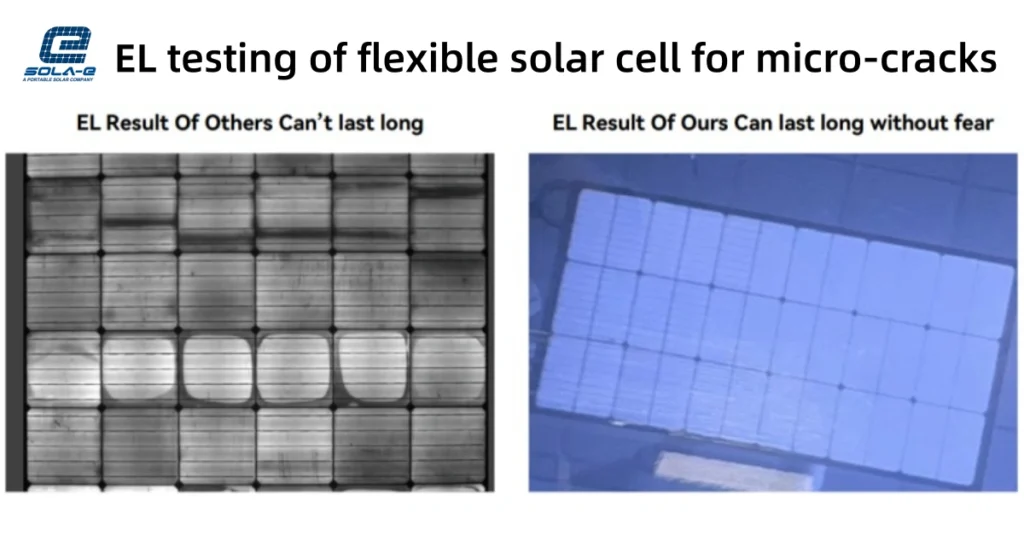
Flexible solar panels are often selected for RVs and campervans because they are lightweight, thin, and easy to integrate into curved or space-constrained roofs.
But one question comes up repeatedly during product development: RV flexible solar panel thermal management.
How do you keep a flexible solar panel from getting too hot on an RV roof?
The answer is not simply to choose a more heat-resistant solar panel.
Once a flexible solar panel is bonded to a vehicle roof, the panel, adhesive, mounting structure, and roof begin to function as one thermal system. How that system absorbs, transfers, and releases heat can affect electrical output, hot-spot risk, adhesive reliability, and long-term durability.
For RV manufacturers and solar-product developers, the more useful engineering question is therefore:
Where can the heat go after the solar panel is installed?
This article examines the thermal factors that should be considered when integrating flexible or lightweight solar panels into RV, campervan, and other vehicle-roof applications.
Quick Answer: Why Do Flexible Solar Panels Get Hot on RV Roofs?
Solar cells convert only part of incoming solar energy into electricity. The remaining energy contributes to heating the module and its surroundings.
The actual operating temperature of an RV solar panel depends on more than the solar-cell technology. Important factors include:
- solar irradiance and ambient temperature;
- wind and backside airflow;
- mounting and bonding method;
- adhesive coverage;
- RV roof construction;
- partial shading;
- and the available path for heat to leave the installed system.
A raised rigid solar module normally has air behind it. A flexible solar panel bonded close to an RV roof may have little or no backside airflow. As a result, two panels using similar solar cells can operate at significantly different temperatures because their installation structures provide different heat-transfer paths.
The panel does not determine its operating temperature alone. The installation architecture matters, too.
1.Why RV Roof Installation Affects Solar Panel Temperature
One of the advantages of a flexible solar panel is that it can be installed close to the vehicle surface.
This provides several practical benefits:
- lower profile;
- lower weight;
- reduced aerodynamic impact;
- easier integration with curved roofs;
- and fewer bulky mounting components.
However, flush or near-flush installation also changes the way heat leaves the module.
With an elevated rigid module, moving air can remove heat from both the front and rear surfaces. With a directly bonded flexible panel, the backside may instead transfer heat through several material layers:
solar cells → laminate → adhesive → RV roof → surrounding environment
The RV roof therefore becomes part of the solar panel’s thermal-management system.
This does not mean direct bonding is inherently unsuitable. It means that direct bonding should be evaluated as both a mechanical and thermal design decision, particularly for vehicles expected to operate in high-temperature or high-irradiance environments.
2.What Happens to Solar Panel Output as Temperature Increases?
Solar-module performance changes with cell temperature.
As photovoltaic cells become hotter, their operating voltage generally decreases — a relationship documented in published research on solar cell temperature coefficients. The exact effect depends on the cell technology and its temperature coefficient, but higher cell temperature can reduce the electrical power available from the module.
For an RV system, this creates an important distinction:
ambient temperature is not the same as cell temperature.
A summer day with an ambient temperature of 35°C does not necessarily mean the cells are operating at 35°C. Under strong sunlight, a poorly ventilated panel mounted over a heat-absorbing roof can operate substantially hotter.
That is why comparing solar panels only by rated wattage or STC specifications does not fully describe how they will perform after vehicle integration.
For OEM projects, thermal behavior should be evaluated in a mounting configuration that represents the intended product.
3.Why Partial Shading and High Temperature Need to Be Considered Together
Temperature is only part of the problem.
On RV roofs, partial shading is difficult to avoid. Common sources include:
- roof vents;
- antennas;
- air-conditioning units;
- cables;
- roof racks and accessories;
- nearby trees and branches.
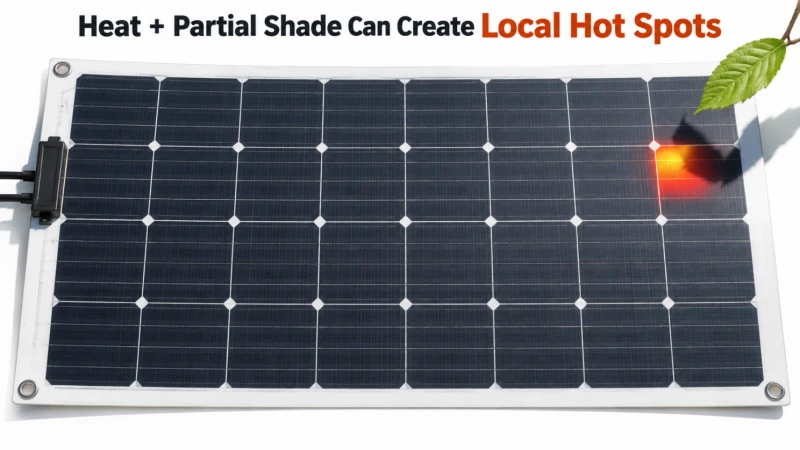
If one solar cell or one section of a series-connected circuit becomes heavily shaded while surrounding cells remain strongly illuminated, the shaded cell can be driven into reverse bias.
Instead of generating power normally, it can begin dissipating electrical energy locally as heat. This is one mechanism behind photovoltaic hot spots.
A useful distinction is therefore:
High temperature can reduce electrical performance. High temperature combined with partial shading can become a reliability concern.
On an already hot RV roof, additional localized heating deserves particular attention because severe hot spots can accelerate material degradation and potentially damage cells or laminate materials.
This means shading architecture and thermal management should not be treated as separate engineering problems.
The electrical design influences where localized stress may develop, while the thermal design influences how effectively that heat can dissipate.
4.Does an Air Gap Help Keep Flexible Solar Panels Cooler?
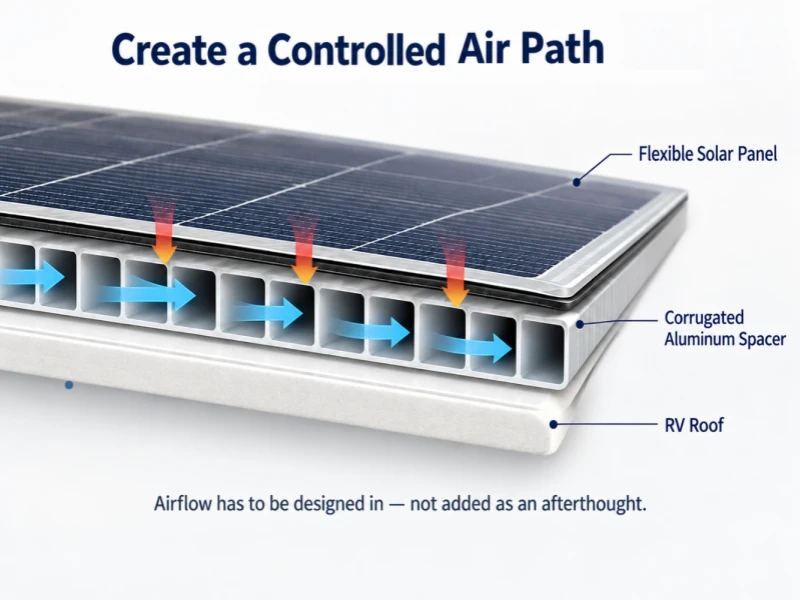
In many applications, backside airflow can help reduce heat accumulation.
But simply specifying an “air gap” does not complete the design.
An RV manufacturer still needs to consider:
- the required gap height;
- whether air can actually enter and exit the gap;
- channel orientation;
- vehicle movement and wind conditions;
- added weight and overall roof height;
- wind loading;
- mounting strength;
- drainage;
- manufacturability;
- and serviceability.
An enclosed gap with little air movement may behave differently from a continuous ventilation channel.
For this reason, ventilation needs to be designed as part of the mounting architecture rather than added as a general specification.
5. A Ventilated Aluminum Backing Structure: One Possible Approach
For some lightweight RV solar-panel projects, one structure worth evaluating is a thin corrugated aluminum backing layer between the solar laminate and vehicle roof.
The concept has two potential functions.
First, aluminum can help spread localized heat laterally.
Second, the corrugated geometry can create continuous channels beneath the solar panel, providing a potential passive airflow path instead of leaving the entire backside as a sealed interface.
A simplified structure might look like:
Solar laminate → Thermally conductive / structural interface → Corrugated aluminum ventilation layer → Air channels → RV roof
The engineering principle is straightforward:
Instead of only asking how much heat the solar panel can tolerate, consider giving that heat a practical path to escape.
However, this should not be presented as a universal solution.
Adding an aluminum backing structure introduces additional:
- weight;
- thickness;
- interfaces;
- bonding requirements;
- manufacturing steps;
- and cost.
The actual temperature reduction will also depend on channel geometry, orientation, airflow, roof construction, bonding strategy, and operating environment. These factors require application-specific validation.
For an OEM project, the objective is therefore not simply to maximize ventilation.
It is to achieve sufficient thermal relief while preserving the low weight, low profile, durability, and manufacturability that made a lightweight solar solution attractive in the first place.
6.Why Adhesive Selection Matters in RV Solar Installation
Heat does not affect only the photovoltaic cells.
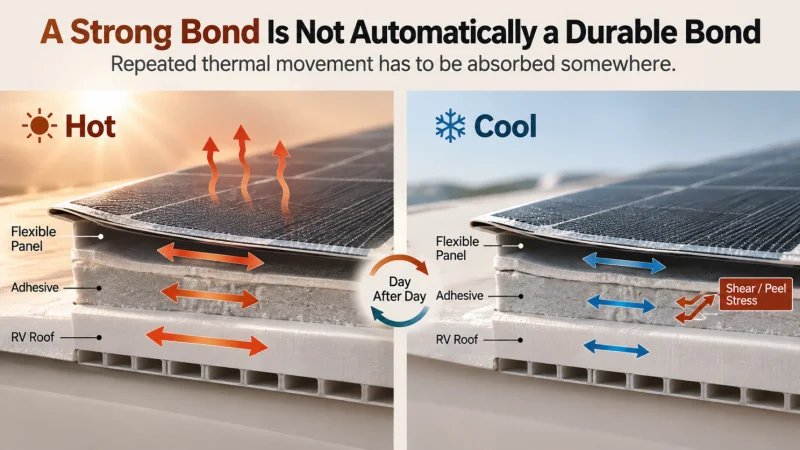
The solar laminate, adhesive layer, aluminum or composite roof, and other mounting materials may have different coefficients of thermal expansion.
As the vehicle heats during the day and cools at night, these materials repeatedly expand and contract.
They do not necessarily move by the same amount.
The adhesive layer therefore has two jobs:
retain the solar panel mechanically;
accommodate repeated movement between dissimilar materials.
Over many thermal cycles, mismatched materials or an unsuitable bonding design can create shear and peel stresses at the interface.
Potential failure modes can include:
- bubbling
- localized lifting;
- adhesive fatigue;
- edge separation;
- and delamination.
This is why simply adding more adhesive or maximizing bond rigidity does not automatically create a more durable installation. We ran into a related version of this problem in our modular solar panel manufacturing work, where the wrong coating chemistry — not the bonding itself — was the actual point of failure.
The adhesive system needs adequate strength while remaining compatible with the thermal movement of the complete roof assembly.
Bonding strategy should therefore be considered during product development, not only when writing the installation manual.
7.Thermal Cycling Can Affect More Than the Solar Cells
When engineers discuss solar-panel temperature, attention naturally goes to the cells.
But repeated heating and cooling acts on the complete assembly, including:
- junction boxes;
- cable exits;
- soldered connections;
- sealants;
- strain-relief structures;
- adhesive interfaces;
- and edge seals.
Vehicle applications add another layer of complexity because these components may simultaneously experience vibration, cable movement, moisture, UV exposure, and mechanical stress.
For example, a junction box can remain electrically functional while its bonding or sealing interface gradually deteriorates.
Similarly, a cable exit may experience repeated thermal expansion, vibration, and pulling forces concentrated around the same location.
For an RV solar system, thermal reliability therefore should not be reduced to a single question such as:
“What is the maximum temperature rating of the solar cells?”
The surrounding interfaces can become the limiting factor.
8.How Should an RV Solar Thermal Design Be Validated?
A flexible solar panel can perform well during a conventional electrical test and still behave differently once permanently integrated into a vehicle roof.
For OEM and ODM development, thermal testing should therefore reproduce the intended installation condition as closely as practical.
A useful validation program may compare:
| Test Item | What It Helps Evaluate |
|---|---|
| Panel front-surface temperature | Solar-side heat accumulation |
| Panel backside temperature | Heat retained behind the laminate |
| RV roof temperature | Heat transfer into the vehicle structure |
| Stabilized electrical output | Performance at operating temperature |
| Ventilated vs. non-ventilated mounting | Effectiveness of the proposed airflow structure |
| IV characteristics before/after thermal cycling | Electrical stability |
| Bonding after heating/cooling cycles | Adhesive and interface durability |
| Junction box and cable exit inspection | Local sealing and mechanical reliability |
The exact test conditions should be defined around the actual product architecture, materials, expected climate, mounting method, and vehicle application.
The important principle is:
Validate the thermal path you actually intend to manufacture and sell.
Testing a solar laminate in open air cannot, by itself, establish how the complete assembly will behave when bonded to an insulated vehicle roof under strong summer sunlight.
9.What RV Manufacturers Should Define Before Selecting a Flexible Solar Panel
For a new RV or campervan solar project, it is useful to evaluate the solar module and roof integration together rather than selecting the panel first and solving mounting later.
Before finalizing the architecture, engineering teams should ideally define:
Roof conditions
Roof material, insulation structure, available installation area, curvature, nearby obstructions, and expected surface temperature.
Solar requirements
Target wattage, system voltage, available PV area, cell layout, MPPT input requirements, and expected partial-shading conditions.
Mechanical requirements
Maximum weight, thickness, mounting method, aerodynamic limitations, vibration environment, and serviceability.
Thermal requirements
Backside airflow, ventilation-channel geometry, adhesive coverage, heat-spreading structure, and target operating environment.
Validation requirements
Thermal cycling, IV testing, hot-spot evaluation, bonding inspection, environmental exposure, and vehicle-level testing.
This approach makes thermal management part of the product architecture rather than a troubleshooting exercise after the solar panel has already been selected.
FAQ: Flexible Solar Panel Heat on RV Roofs
Q1: Do flexible solar panels get hotter than rigid solar panels?
Not necessarily because they are flexible. The mounting configuration is an important factor. A raised rigid panel typically has backside airflow, while a flexible panel bonded close to a roof may have a more restricted heat-dissipation path.
Q2: Can you glue a flexible solar panel directly to an RV roof?
Direct bonding can be a viable integration method, but it changes the module’s thermal path and should be evaluated together with the roof material, adhesive system, temperature cycling, and expected operating environment.
Q3: Does an air gap under a solar panel improve cooling?
Backside airflow can help remove heat, but performance depends on whether air can actually move through the gap. Gap geometry, channel direction, vehicle airflow, mounting design, and roof structure all matter.
Q4: Can partial shade cause solar-panel hot spots?
Yes. A heavily shaded cell in a series-connected section can experience reverse-bias conditions and dissipate energy locally as heat, which can create a hot spot.
Q5: What should OEMs test before integrating solar panels into an RV roof?
Useful evaluations can include front and backside panel temperatures, roof temperature, stabilized electrical output, ventilated versus non-ventilated mounting, IV performance before and after thermal cycling, bonding condition, and inspection of junction boxes and cable exits.
Developing a Custom Solar Panel for an RV or Campervan?
For an OEM RV solar project, panel wattage is only one part of the engineering problem. The available roof area, cell layout, electrical configuration, panel thickness, weight, mounting structure, airflow, bonding method, cable routing, and expected operating environment can all influence the final design.
If you are developing a new RV, campervan, overlanding vehicle, or mobile-energy platform, send us your:
- Roof drawing or available installation area
- Target wattage and system voltage
- Weight and thickness requirements
- Mounting or bonding concept
- Cable and connector requirements
- Expected operating environment
- Expected annual volume
- Required certifications or validation tests
Sola-E can evaluate the available cell area, electrical configuration, material stack, mechanical layout, thermal-management concept, and manufacturing feasibility before the final specification is frozen.

Sam | Solar Application Specialist
With over 10 years of experience in the photovoltaic manufacturing industry, Sam specializes in risk control and application engineering for portable battery chargers and marine solar panel solutions. He helps OEMs and distributors bridge the gap between technical specs and real-world performance.