For a long time, an RV solar panel system was easy to describe in one line:
Solar panel → MPPT controller → house battery.
That architecture still works. It’s not wrong. But it no longer describes the whole picture in a growing number of modern RVs. Solar now often shares the job with alternator charging, shore power, larger lithium battery banks, inverter/chargers, deployable or portable solar, and increasingly integrated power-management systems.
The real shift isn’t that there are more components in the system. It’s that how those components relate to each other now matters more than any single one of them.
So the question we get asked more often isn’t “how many watts do I need.” It’s becoming:
What role should solar actually play inside the RV’s total energy budget?
Table of Contents
Quick Answer: Why Can’t I Just Specify a Wattage Anymore?
A wattage number tells you the panel’s peak output. It doesn’t tell you how that panel needs to behave once it’s wired into a real RV electrical system.
The panel’s actual specification depends on:
- what PV input-voltage range the charge controller accepts;
- what battery-system voltage the RV uses (12V, 24V, or 48V);
- whether solar is the only charging source, or one of several;
- whether a second array (roof, awning, or portable) will share the same MPPT input or use a separate channel;
- the shading pattern the panel will actually face on the roof;
- how much usable roof area exists once vents, AC units, and antennas are accounted for.
Two RVs can both specify “400W of solar” and need completely different panels underneath that number.
The Real Change Is Integration, Not Just “More DC-DC”
DC-DC charging isn’t new. Neither is combining a DC-DC charger with MPPT solar input — REDARC has offered dual-input chargers that accept both alternator and solar simultaneously for years, with solar-priority logic available on some models.
What’s changed is how naturally this integration now fits the direction the rest of the RV electrical system is heading.
The old architecture was simple to draw as two separate diagrams:
Alternator → DC-DC charger → house battery
Solar → MPPT → house battery
An integrated system manages both inside the same charging architecture, and the sources don’t take turns — they can contribute at the same time. While driving, the battery may pull from both the alternator and the roof panel. Once the engine stops, solar can keep going on its own. When shore power connects, the charger or inverter/charger joins the mix too.
That reframes the real engineering question: which sources are available at any given moment, how much can each contribute, and how should the system balance them?
2. Solar’s One Real Advantage: It Doesn’t Care What State the Vehicle Is In
Every charging source has a condition attached to it.
Alternator charging needs the engine running. Shore power needs an external hookup. A generator needs fuel and someone to start it. A battery stores energy, but it eventually needs to be refilled from somewhere.
Solar’s condition is simpler: as long as there’s enough light hitting the panel, it keeps contributing — moving or parked, engine on or off, connected to shore power or completely off-grid.
That doesn’t make it the fastest source. A strong alternator will out-charge a rooftop panel while driving. A shore connection can run large loads and charge at the same time. But solar is the only source with no dependency on the vehicle’s state.
That matters more as RV power demand grows. A bigger battery stores more energy — it doesn’t generate more. If air conditioning, induction cooktops, or always-on connectivity gear push daily consumption up, something still has to refill that battery. Usually that’s some combination of solar, alternator, and shore power working together.
3. One RV Can Now Run More Than One Kind of Solar
The panel doesn’t have to be a single fixed rooftop array anymore.
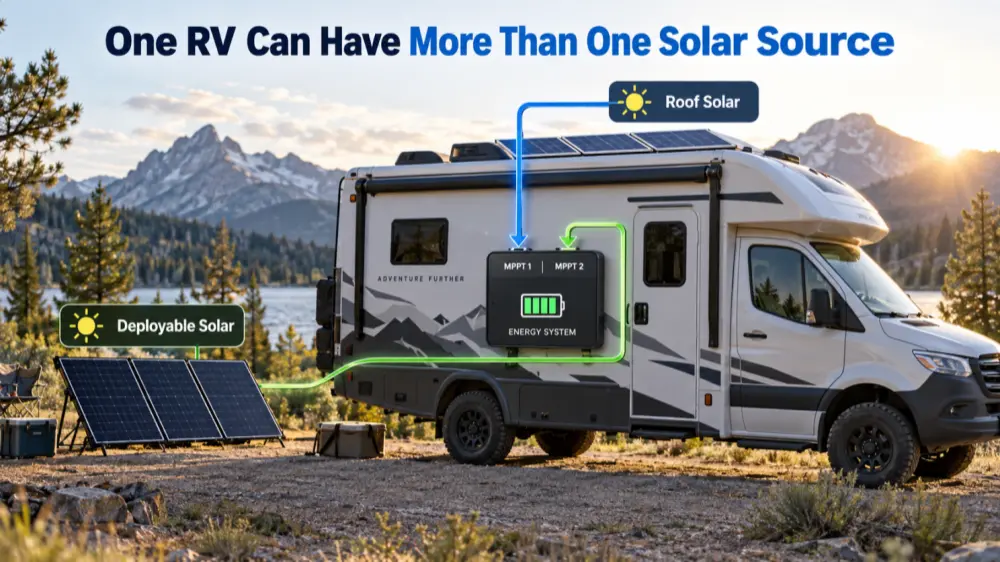
An RV can combine a fixed roof array with a deployable one — awning-integrated solar, portable panels, or both. Awnlux showed a solar-awning concept alongside conventional roof systems at CARAVAN SALON 2026, and it’s a good example of why this trend matters: a deployable surface can add collecting area without permanently taking up roof space that vents, skylights, and antennas already compete for.
But electrically, adding a second array isn’t as simple as “more panels, same system.”
A roof array and a deployable array usually operate under different conditions — different orientation, different shading, different temperatures, different cable runs. Put two arrays with meaningfully different operating conditions on the same MPPT input, and you can end up forcing a compromise that holds both back. Separate MPPT channels let each array chase its own maximum power point independently — though whether that’s worth the added complexity depends on array voltage and current, controller limits, and wiring topology.
The point that matters for panel design: more PV area doesn’t automatically mean one bigger, uniform solar array. The architecture itself is becoming more distributed.
4. This Changes What “Specify a Panel” Actually Means
This is where it gets directly relevant to how we build panels.
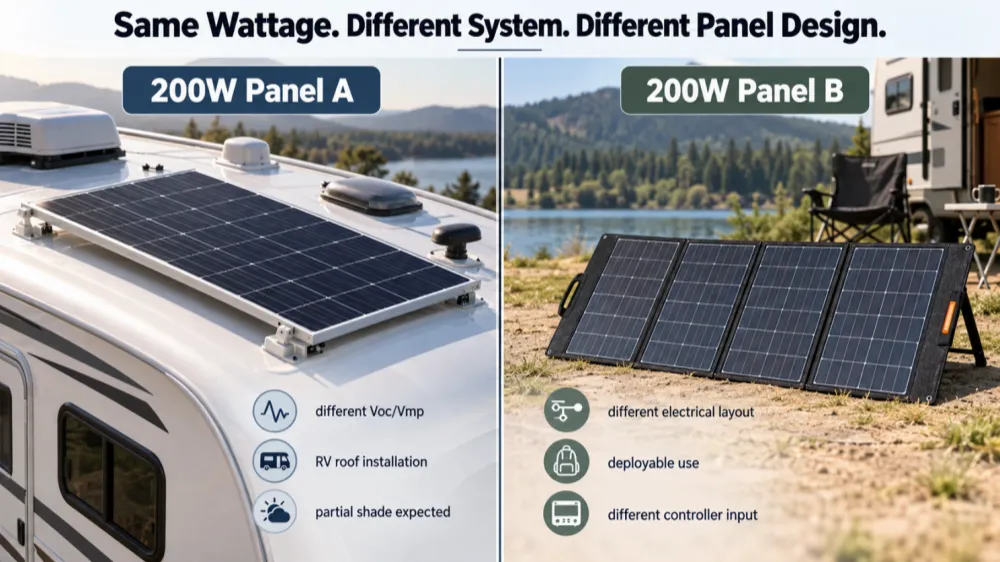
In custom mobile-solar development, “we need a 200W panel” is rarely a complete answer on its own — because 200W tells us the target output, but nothing about how that panel needs to behave once it’s wired into the vehicle’s electrical system.
We still need to know things like:
- What PV voltage and current range does the controller accept?
- What’s the house battery voltage?
- Is this panel the only PV source, or will another roof, awning, or portable array join it?
- Will multiple arrays share one MPPT channel or run on separate ones?
- What shading pattern should we expect from nearby roof equipment?
- How much usable roof area is actually available?
Those answers shape real design decisions inside the panel: cell count, Voc and Vmp, series/parallel layout, bypass-diode segmentation, connector choice, physical dimensions, even overall form factor.
Voltage is a simple example of why this matters. MPPT controllers have defined PV voltage and current limits — wiring cells in series raises array voltage, wiring in parallel raises current, and shading behavior changes depending on which layout you use. Victron’s own solar guidance is explicit that controller selection depends on array Voc, Isc, and the battery system voltage together, not any one number in isolation.
We see this constantly in custom projects: the same 200W target can produce very different panel designs depending on the charging architecture sitting behind it. A roof panel boxed in by vents and antennas will face repeated partial shading — something we cover in more depth in our flexible RV solar panel thermal management guide. A deployable panel set away from the vehicle often sees much cleaner sun exposure, but comes with different cable-length and deployment requirements. Different environments justify different product decisions, even when both panels are nominally “solar.”
Multi-source charging doesn’t make the panel less important. It makes the panel spec more dependent on the system around it.
5. 48V Is Worth Watching — It’s Not the Whole Story
48V systems deserve attention for a straightforward electrical reason: for the same power delivered, higher voltage means lower current. A 3kW load at 12V draws roughly four times the current of the same load at 48V, before conversion losses even enter the picture. That makes 48V attractive for large inverter loads, long cable runs, and increasingly power-hungry RV builds.
But that electrical advantage doesn’t mean the whole RV market is about to move to 48V overnight. A large share of existing RV appliances — pumps, fans, lighting, control systems — still run on 12V. Victron’s current guidance itself notes that 12V remains the right fit for most RV use cases, while 24V or 48V make more sense for higher-power loads, longer cable runs, or higher-voltage appliances specifically.
Moving the house battery to 48V doesn’t automatically convert every 12V device in the RV. Voltage conversion is often still required somewhere in the system.
So it’s worth being careful with a claim like “48V is the future of RV electrification.” It’s more accurate to say 48V is one architectural response to a broader trend: RV electrical demand is rising, and charging, storage, and conversion are becoming more integrated. 48V helps with that in higher-power builds. It isn’t the trend itself.
6. Solar Needs to Enter the Design Earlier, Not Later
The practical conclusion from all of this: solar shouldn’t be the last thing bolted onto an RV design. But it also shouldn’t be specified first, with everything else forced to work around it.
The better approach is designing the energy system and the solar array together, starting from the use case:
- What loads does the RV need to run, and how much daily energy do they use?
- How much off-grid autonomy is actually required?
- What’s the charging picture while driving versus while parked?
- How often will shore power realistically be available?
- How much can the alternator reasonably contribute?
- How much usable roof area exists, and could a deployable array add meaningful extra capacity?
From there, the battery bank, inverter, charging sources, controller architecture, and solar array can all be defined together, instead of one dictating the rest.
400W is a solar specification. It isn’t an energy architecture. Two RVs can both carry 400W of solar and behave completely differently — one with a small battery and light loads, another with a large lithium bank, a 3kW inverter, air conditioning, and strong alternator charging. The same panel wattage means something different in each case.
Solar Is Becoming Less Standalone — Not Less Important
More DC-DC charging, bigger batteries, and integrated power systems don’t push solar out of the picture. They make its role more specific.
The alternator contributes strongly while the engine runs. Shore power charges the battery and runs loads when infrastructure is available. The battery stores energy and supplies the vehicle when generation falls short. And solar contributes whenever there’s enough light — driving, parked at camp, or fully off-grid.
The useful question isn’t which source wins. It’s how they complement each other — and from the panel side, that leads to one principle worth designing around:
Define the energy architecture the panel has to work inside, before you specify the panel itself.
The future of RV solar isn’t solar-only. It’s solar designed as part of the vehicle.
FAQ: Solar Panels for Multi-Source RV Charging Systems
Q1: Can solar and alternator charging work at the same time in an RV?
Yes, in an integrated system. Some DC-DC chargers accept both alternator and solar input simultaneously, with solar-priority logic available in some models, so the house battery can draw from both sources at once while driving.
Q2: Do I need separate MPPT channels for a roof panel and a deployable/awning panel?
It depends. If both arrays have significantly different voltage, current, shading, or temperature conditions, running them on separate MPPT channels can let each operate closer to its own maximum power point. Whether that’s worth the added complexity depends on the specific controller limits and wiring topology.
Q3: Is 48V better than 12V for RV solar systems?
Not universally. 48V reduces current for the same power output, which helps with large inverter loads and long cable runs. But most RV appliances still run on 12V, so a 48V house battery often still needs voltage conversion for everyday loads. 12V remains suitable for most RV use cases.
Q4: Why isn’t a wattage number enough to specify an RV solar panel?
Because wattage only describes peak output. It doesn’t capture the PV voltage range the controller needs, the battery system voltage, whether the panel shares an MPPT channel with another array, or the shading pattern it will actually face — all of which shape the panel’s real design.
Designing a Custom Solar Panel for a Multi-Source RV Energy System?
If you’re developing an RV, campervan, or overlanding platform with more than one charging source in the mix, the panel spec needs to be built around the full energy architecture — not the other way around.
- Your target wattage and system voltage (12V / 24V / 48V)
- Your controller’s PV voltage and current limits
- Whether solar will share an MPPT channel with another array
- Your available roof area and expected shading sources
- Your deployment concept, if you’re including a portable or awning array
- Your expected annual volume and required certifications
Sola-E can evaluate cell layout, electrical configuration, and mechanical design against your actual charging architecture before the specification is frozen.

Sam | Solar Application Specialist
With over 10 years of experience in the photovoltaic manufacturing industry, Sam specializes in risk control and application engineering for portable battery chargers and marine solar panel solutions. He helps OEMs and distributors bridge the gap between technical specs and real-world performance.