Executive Summary
Designing an off-grid solar system is not about matching wattage—it is about eliminating system failure risk.
Most B2B deployments fail due to one issue: undersized solar input relative to real-world consumption.
A system that works on paper can still fail in 3–5 days under real conditions.
This guide provides a practical sizing framework used by OEM buyers and field engineers to ensure stable, continuous operation.
Table of Contents
1. Quick Answer: Solar Panel Size by Battery Capacity
If you need a fast, decision-ready answer, use this baseline:
| Battery Capacity | Minimum (Survival) | Recommended (Stable) | Professional (Redundancy) |
| 500Wh | 100W | 150W | 200W |
| 1000Wh | 200W | 300W | 400W |
| 2000Wh | 300W | 400W | 600W |
Key Insight:
If you are searching for “solar panel size for 1000Wh battery”, the real answer is:
- 200W → system barely survives
- 300W → stable daily operation
- 400W → engineered reliability
Charging behavior and battery performance vary significantly under different load conditions, as explained by
Battery University.
2. The Core Sizing Formula (Simplified for Real Use)
Instead of theoretical calculations, use this practical model:
[P_{panel} = \frac{E_{load}}{H_{sun} \times \eta} \times Safety\ Factor ]
In simple terms: Panel Size = Your Daily Power Needs ÷ Sunlight × Losses × Safety Margin
What it actually means:
- E_load = Daily energy consumption (Wh)
- H_sun = Peak sun hours (typically 3–5)
- η (efficiency) = 0.7–0.85 (real-world losses)
- Safety Factor = 1.2–1.5 (critical for stability)
Plain-English Translation:
Your solar panel must produce more energy than you consume, even on bad days.
3. The Real Problem: Energy Gap Risk
The biggest failure point in off-grid systems is not hardware quality— it is negative energy balance.
What happens in real deployments:
| Day | System Behavior |
| Day 1 | Battery fully charged |
| Day 2 | Slight deficit appears |
| Day 3 | System enters negative cycle |
| Day 4–5 | Critical shutdown |
This is called:
Energy Gap Risk
When Daily Consumption > Daily Solar Input, your system will inevitably fail, even if all components are “working perfectly”.
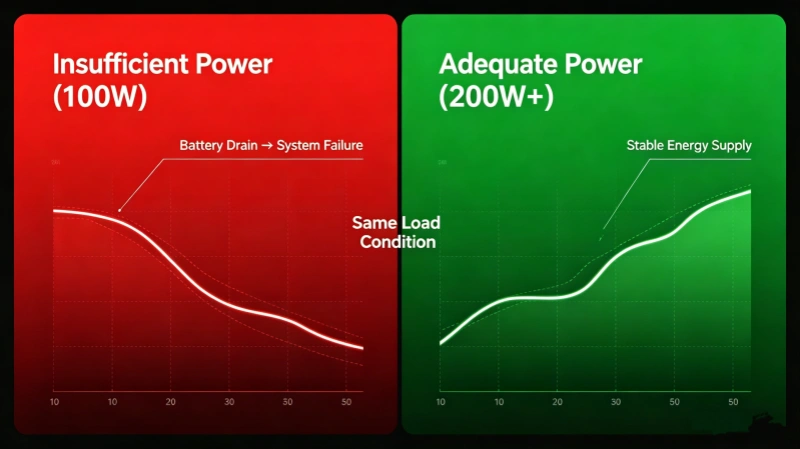
Undersizing is the leading cause of system failure.
See a detailed breakdown in our guide: Why Portable Solar Panels Fail: User Error vs Product Defects
4. Why 100W–200W Systems Often Fail (1000Wh Scenario)
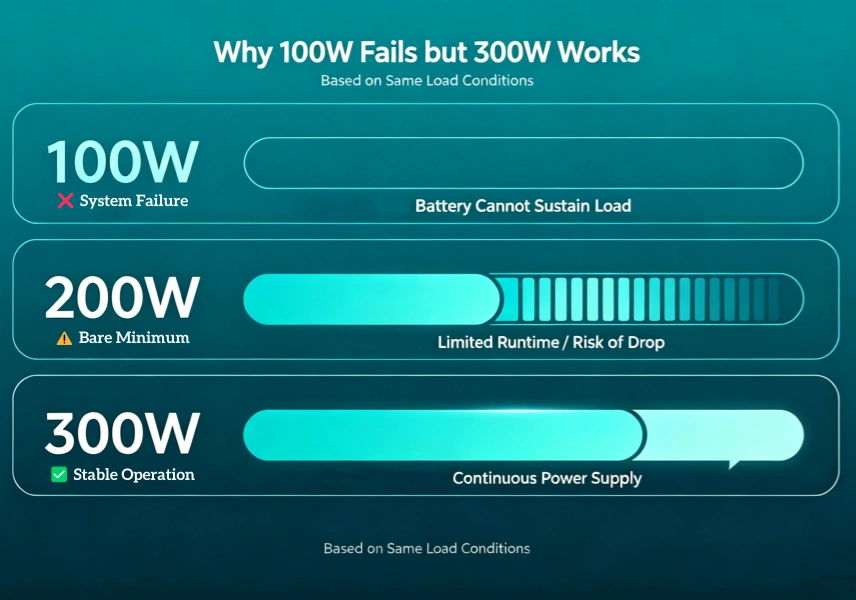
Real Field Example:
Battery: 1000Wh
Load: 600Wh/day
Using 100W panel:
- Output ≈ 400–450Wh/day
- Result: Deficit of ~150Wh/day
- Outcome: System collapse in ~3 days
Using 200W panel:
- Output ≈ 800Wh/day
- Result: Positive energy balance
- Outcome: Stable operation
Not sure whether 100W or 200W is enough?
Read our detailed comparison: 100W vs. 200W: Which Portable Solar Panel Suits Your Power Station?
Conclusion:
A 100W panel is not “smaller” — it is structurally insufficient for high-load systems.
5. Worst Month Design (Critical for B2B Projects)
Most systems are designed based on average conditions. This is a major mistake.
Correct approach:
Design for The worst solar month of the year
Because:
- Winter sun hours can drop by 40–60%
- Cloud coverage increases losses
- Temperature reduces efficiency
Engineering Rule:
If your system works in winter, it will overperform in summer.
If it only works in summer, it will fail in winter.
Learn how material affects performance: ETFE vs PET Solar Panels Guide
6. System Stability = Panel + Battery + Margin
A stable system is not defined by panel size alone.
It requires:
1. Solar Input Margin
Panels must exceed consumption.
2. Battery Buffer
Battery must cover 1–2 days of autonomy
3. Environmental Tolerance
System must survive:
- Heat (efficiency loss)
- Dust (output drop)
- Angle mismatch
Stability Formula (Conceptual):
Stability = Input ≥ Consumption + Losses + Variability
This is why high-efficiency HPBC cells and ETFE coating are mandatory for mission-critical deployments.
System stability is not only about sizing, but also build quality.
Learn how high-performance panels are engineered: Inside the Factory: How High-Performance Foldable Solar Panels Are Manufactured
7. 3 Critical Sourcing Mistakes (OEM Buyers)
Mistake 1: Designing for Ideal Conditions
Ignoring clouds, heat, and angle losses.
Mistake 2: Choosing Based on Cost per Watt
Lower cost systems often fail faster → higher total cost.
Mistake 3: Ignoring Deployment Type
Different environments require different solutions:
- Vehicles → aerodynamic + lightweight
- Marine → corrosion resistance
- Rooftop → structural load
8. Where This Design Model Breaks
This model does NOT apply well in:
- Extreme cold (< -20°C without battery heating)
- Long-term low sunlight regions (>5 cloudy days)
- Heavy shading environments
In these cases, hybrid systems or oversizing is required.
9. Final Engineering Decision
If your system is:
<700Wh: → 100W acceptable
1000Wh–2000Wh: → 200W minimum → 300W recommended
Mission-critical systems: → 400W+ mandatory
Rule of Thumb:
If daily usage exceeds 500Wh, a 100W panel will create a guaranteed Energy Gap Risk.
10. FAQ (For B2B Buyers & System Designers)
Q1: How accurate is a solar panel sizing calculator for off-grid systems?
A solar panel sizing calculator provides a baseline estimate, but real-world performance depends on:
- Temperature losses
- Panel angle and shading
- Cable and controller efficiency
- Seasonal sunlight variation
For B2B projects, a calculator alone is not enough. A safety factor (1.2–1.5) must be applied to avoid underperformance.
In practice, most system failures are caused by relying on ideal calculations without accounting for real conditions.
Q2. Why does my solar panel never reach its rated power output?
Rated wattage (e.g., 100W or 200W) is measured under Standard Test Conditions (STC), which rarely exist in real environments.
Typical real-world output is:
- 70%–85% of rated power
Losses come from:
- High temperature
- Non-optimal sunlight angle
- Dust and surface contamination
- Electrical conversion losses
Q3. What size solar panel do I need for a 1000Wh battery?
This is one of the most common sourcing questions.
- 100W–150W: Not sufficient (high risk of system failure)
- 200W: Minimum viable operation
- 300W: Recommended for stable daily use
- 400W+: Professional-grade redundancy
- If your daily usage exceeds 500Wh, using a 100W panel will create a negative energy cycle, leading to system shutdown within days.
Q4. How do I avoid system failure in off-grid solar setups?
The key is to eliminate Energy Gap Risk, which occurs when:
Daily energy consumption exceeds solar energy production.
To prevent this:
- Size panels based on worst-month sunlight, not average
- Ensure solar input exceeds load by at least 20–50%
- Include battery capacity for 1–2 days of autonomy
A properly designed system should remain stable even during consecutive low-sun days.
Q5. Is it better to oversize the solar panel or the battery?
For most B2B applications, oversizing the solar panel delivers better ROI.
Reasons:
- Faster recharge time
- Higher tolerance to weather variability
- Reduced risk of system downtime
Oversizing the battery without increasing panel input can still lead to slow charging and eventual energy deficit.
In field operations, insufficient solar input is a far more common failure point than insufficient battery capacity.
Q6. Can I use a 100W panel for a professional off-grid system?
Only in limited scenarios:
- Low-power loads (<300Wh/day)
- Short-duration deployments
- Backup or emergency use
For any continuous or mission-critical system, a 100W panel is typically undersized by design.
Need a faster answer?
Try our step-by-step guide: Solar Panel Sizing Calculator Guide
Avoid System Failure Before Deployment
Most off-grid systems don’t fail because of poor components — they fail due to incorrect sizing. Our engineers will simulate your system to ensure it delivers stable power under real-world conditions.
Your customized system report includes:
- Solar Panel Sizing Simulation (based on your actual load & location)
- Energy Gap Risk Analysis (identify failure scenarios before deployment)
- Worst-Month Performance Forecast (winter & low-sun conditions)
- Recommended Configuration (200W / 300W / 400W+ system design)
*Free technical service for OEM & Commercial Buyers.

Sam | Solar Application Specialist
With over 10 years of experience in the photovoltaic manufacturing industry, Sam specializes in risk control and application engineering for portable battery chargers and marine solar panel solutions. He helps OEMs and distributors bridge the gap between technical specs and real-world performance.