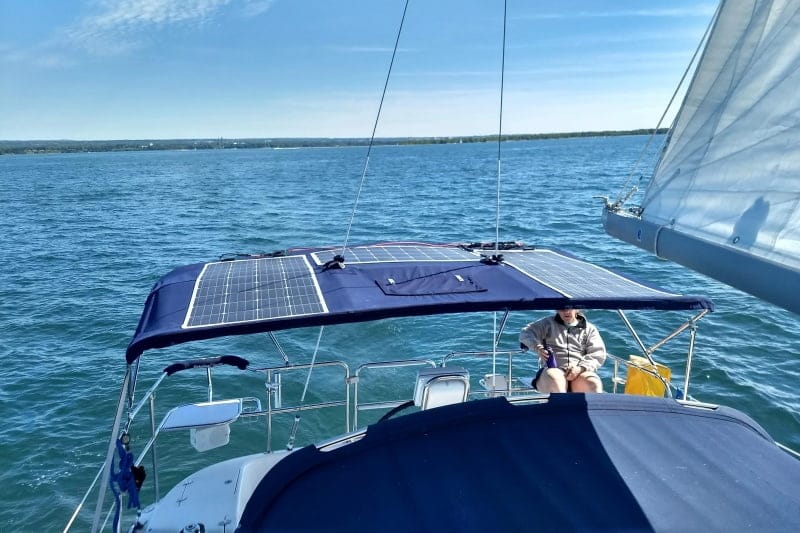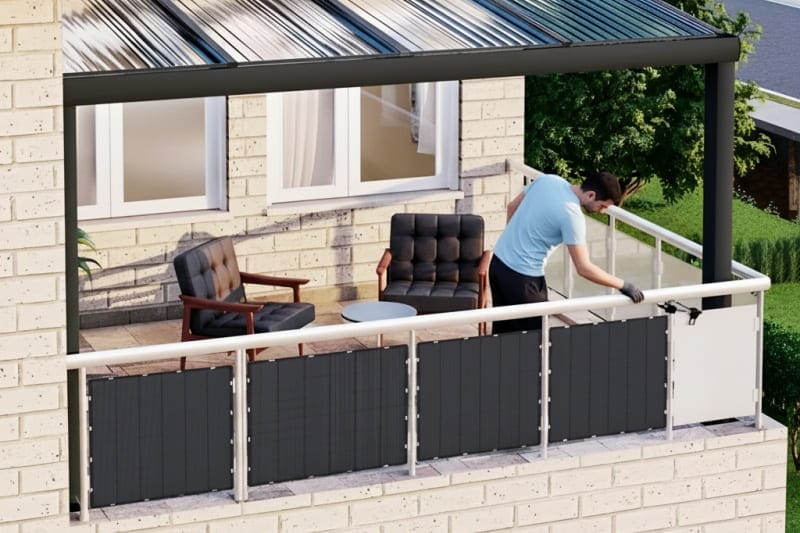
The Professional Consensus: In B2B field operations, the choice between a 100W foldable and a 200W portable solar panel is not just about 80 watts—it’s about the “Recharge Window.” For batteries over 1000Wh, 200W is the benchmark for single-day autonomy.
Table of Contents
1. The 100W Foldable: The Lightweight Specialist
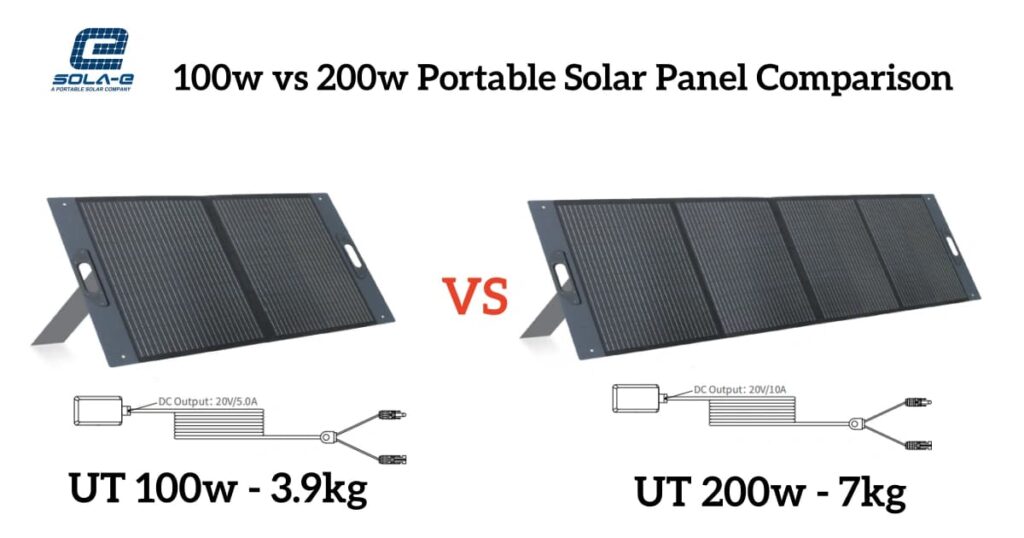
The 100W foldable panel is designed for ultra-mobility. It is the ideal companion for mid-range power stations (500Wh–700Wh) used in lighter field tasks.
- Pros: Extremely lightweight (approx. 3.5kg), fits into standard tactical backpacks, and has the lowest initial CapEx.
- Cons: Slow recharge times for large batteries. In typical 4-hour peak sun conditions, it only yields ~450Wh per day.
- Best For: Charging laptops, drones (Mavic series), and 5G routers for short-duration missions.
2. The 200W Portable: The Industrial Workhorse
A 200W portable solar panel is the standard for professional “Mobile Offices” and high-drain equipment.
- Pros: Optimized for 1000Wh–2000Wh stations. It typically yields 800Wh–1000Wh per day, providing enough “buffer” to handle hazy weather or high-heat efficiency drops.
- Cons: Larger footprint (usually 4-fold) and a slightly higher weight (5.5kg–7kg).
- Best For: Starlink stations, portable fridges, high-end medical gear, and multi-day off-grid deployments.
The Technology Breakdown: 100W vs. 200W
- 100W Foldable (The Lightweight Specialist): Best for ultra-mobility where every gram counts. Ideal for 500Wh–700Wh entry-level stations.
- 200W Portable (The Industrial Workhorse): The standard for “Mobile Offices.” Engineered for 1000Wh–2000Wh professional setups where uptime is non-negotiable.
3. The “Recharge Math”: 100W vs. 200W
| Power Station Capacity | 100W Foldable (Recharge Time) | 200W Portable (Recharge Time) |
| 512Wh (Entry) | ~5-6 Hours (1 Day) | ~3 Hours (Half Day) |
| 1024Wh (Standard) | ~11-12 Hours (2 Days) | ~6-7 Hours (1 Day) |
| 2048Wh (High Capacity) | ~22 Hours (3+ Days) | ~12-14 Hours (2 Days) |
Daily Energy Balance (Real Scenario)
| Scenario | Daily Consumption | 100W Output | 200W Output | Result |
| Light Use | 300Wh | 450Wh | 900Wh | ✅ Both OK |
| Field Ops | 600Wh | 450Wh | 900Wh | ❌ 100W Fails |
| Starlink Setup | 800Wh | 450Wh | 900Wh |
The “Energy Gap Risk”
The #1 reason B2B solar deployments fail is not hardware quality, but undersized panels. When daily consumption exceeds solar intake, your system enters a negative energy cycle. Choosing a 100W panel for a high-drain 1000Wh system creates a long-term Energy Gap, leading to inevitable system blackout within 48-72 hours.
This is one of the most common reasons portable solar systems fail in real deployments.
👉 Learn more in our guide: Why Portable Solar Panels Fail
Final Engineering Decision
If your power station is:
- Below 700Wh: A 100W foldable panel is sufficient for daily recharge.
- Between 1000Wh – 2000Wh: A 200W portable panel is the minimum requirement.
- Above 2000Wh or mission-critical: 200W is not optional; it is mandatory.
Rule of Thumb: If your daily energy consumption exceeds 500Wh, choosing 100W will create a critical Energy Gap Risk. This creates what we call a Recharge Window Failure—when your system cannot fully recharge within available sunlight hours, leading to cumulative energy loss over multiple days.
If you’re still unsure about the correct solar panel size for 1000Wh battery, the key is ensuring your system can fully recharge within a single daylight cycle.
4. Sourcing Considerations for OEM Managers
A. Logistics vs. Uptime
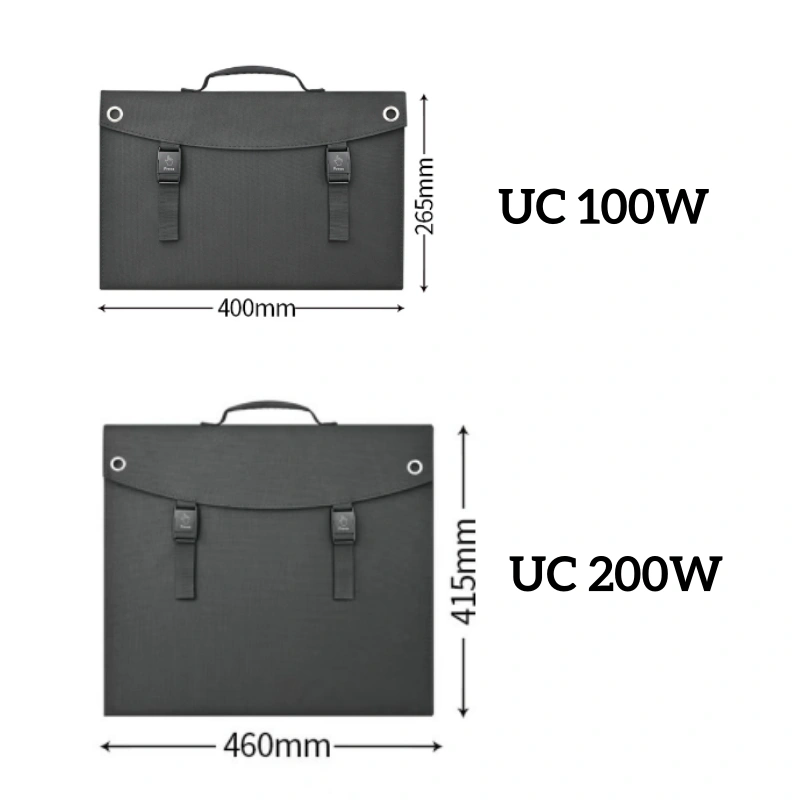
If your team is hiking long distances, the 100W foldable‘s 2kg weight saving is critical. However, if your team is vehicle-based, the 200W portable solar‘s charging speed offers far better ROI through reduced downtime.
B. The “Efficiency Decay” Factor
Real-world output is rarely 100% of the rating. According to U.S. Department of Energy, solar systems often experience efficiency losses due to temperature, irradiance variation, and system mismatch.
- A 100W panel in 35°C heat might only yield 90W.
A 200W panel in the same conditions still yields ~160W.
- For critical gear, that 70W difference is the margin between “System Online” and “Critical Battery Low.”
C. Universal Voltage Compatibility
Our 200W models are engineered with a Voc of 20V–24V, making them natively compatible with 90% of industrial power stations. The 100W models are often optimized for smaller, 12V-system controllers.
Once you’ve determined the correct wattage, the next risk is product reliability.
👉 See how our panels are tested: Inside the Factory
FAQ: Choosing Between 100W and 200W Solar Panels
Q1: Is a 100W solar panel enough for a 1000Wh power station?
In most real-world conditions, a 100W panel is not sufficient for a 1000Wh system.
While it may generate around 400–500Wh per day under ideal sunlight, this often creates an Energy Gap Risk—where daily consumption exceeds solar input.
For reliable daily operation, a 200W panel is the recommended minimum to ensure full recharge within a single daylight cycle.
Q2: What is the ideal solar panel size for a 1000Wh battery?
The ideal solar panel size for a 1000Wh battery depends on your daily energy usage and available sunlight hours.
As a general guideline:
Light usage (<400Wh/day): 100W may be sufficient
Moderate usage (500–800Wh/day): 200W is recommended
High usage (>800Wh/day): 200W+ or dual-panel setup is required
For B2B applications, 200W is considered the baseline for stability.
Q3: How much faster is a 200W solar panel compared to 100W?
A 200W panel can reduce recharge time by 40–50% compared to a 100W panel.
For example:
1000Wh battery
100W: ~10–12 hours (2 days)
200W: ~6–7 hours (1 day)
This difference is critical in field operations where sunlight hours are limited.
Q4: Can I use two 100W panels instead of one 200W panel?
Yes, using two 100W panels can achieve similar total output—if properly connected and positioned.
However, there are trade-offs:
More cables and setup complexity
Higher risk of mismatch losses
Less convenient for mobile deployment
For most commercial and OEM applications, a single 200W panel is more efficient and reliable.
Q5: Why does my solar panel never reach its rated wattage?
Solar panels rarely operate at 100% of their rated power due to real-world conditions such as:
High temperatures (efficiency drops)
Suboptimal sunlight angle
Dust or shading
System conversion losses
For example:
A 100W panel may output ~80–90W
A 200W panel may output ~150–170W
This is why oversizing your panel (e.g., choosing 200W) is critical for avoiding energy shortages.
The Engineering-Grade CTA
Get Your 24-Hour Power Autonomy Report
If you’re unsure whether your system has an Energy Gap Risk, don’t wait until deployment failure. Our engineering team will provide a verified energy simulation for your specific project needs.
Your customized PDF report will include:
- Recharge Time vs. Consumption Matrix (100W vs. 200W side-by-side).
- Energy Gap Risk Assessment (Calculated by season and location).
- Final Sizing Recommendation (100W / 200W / 400W configurations).
*Free technical service for OEM & Commercial Sourcing Managers.

Sam | Solar Application Specialist
With over 10 years of experience in the photovoltaic manufacturing industry, Sam specializes in risk control and application engineering for portable battery chargers and marine solar panel solutions. He helps OEMs and distributors bridge the gap between technical specs and real-world performance.