Executive Summary
Most solar systems do not fail because of poor hardware—they fail because the panel is undersized by 20–40%.
The correct sizing method must account for:
- Real-world system losses
- Seasonal solar variation
- Energy Gap Risk (when consumption exceeds production)
This guide provides a practical engineering method to calculate the correct solar panel size for B2B applications.
Table of Contents
1. Instant Sizing Rule (Quick Reference)
If you need a fast estimate:
- 300Wh/day → 100W–150W
- 500Wh/day → 150W–200W
- 800Wh/day → 200W–300W
- 1000Wh/day → 300W–400W
These values already include real-world inefficiencies. Lower sizing will increase failure risk.
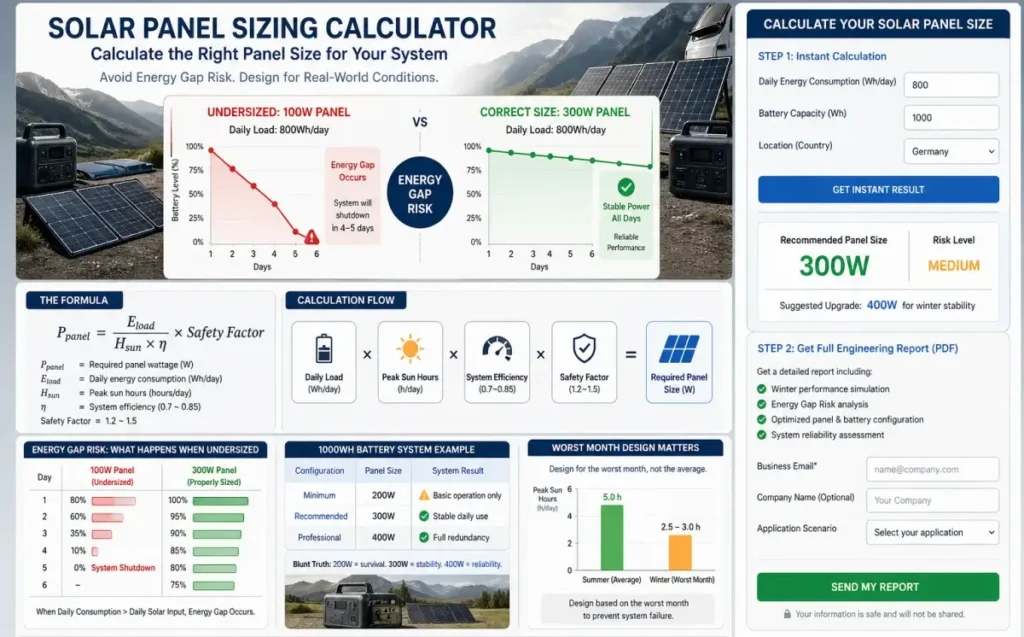
2. The Engineering Formula (Accurate Method)
P_{panel} = \frac{E_{load}}{H_{sun} \times \eta} \times Safety\ Factor
In simple terms: Panel Size = Your Daily Power Needs ÷ Sunlight × Losses × Safety Margin
Parameter Definition
P_panel = Required panel wattage (W)
E_load = Daily energy consumption (Wh/day)
H_sun = Peak sun hours (hours/day)
η (System Efficiency) = 0.7–0.85
Safety Factor = 1.2–1.5
Why Efficiency Matters
System efficiency includes:
- Temperature loss
- MPPT conversion loss
- Cable loss
- Dust and angle loss
Ignoring η typically leads to undersizing.
3. Step-by-Step Calculation Example
Step 1: Define Daily Load
Example:
- Starlink: 60W × 10h = 600Wh
- Router: 10W × 10h = 100Wh
- Laptop: 50W × 4h = 200Wh
Total: E_load = 900Wh/day
Step 2: Select Peak Sun Hours
Use conservative values:
- Europe: 3–4h
- USA: 4–5h
- Tropical: 5–6h
Recommended for B2B design: H_sun = 4h
Step 3: Apply Efficiency and Safety Factor
Assume:
- η = 0.75
- Safety Factor = 1.3
Step 4: Final Result
P = 900 ÷ (4 × 0.75) × 1.3 ≈ 390W
Conclusion: A 400W system is required for stable operation.
4. The Energy Gap Risk (Critical Concept)
The most common reason solar systems fail is undersizing.
Energy Gap occurs when: Daily Consumption > Daily Solar Production
Failure Timeline Example (Undersized System)
| Day | Battery Level |
| Day 1 | 80% |
| Day 2 | 60% |
| Day 3 | 35% |
| Day 4 | System shutdown |
This is a gradual failure, but once it begins, it is unavoidable.
5. Solar Panel Size for 1000Wh Battery
This is one of the most common B2B queries.
Correct engineering recommendations:
| Configuration Level | Panel Size | Result |
| Minimum | 200W | Basic operation only |
| Recommended | 300W | Stable daily use |
| Professional | 400W | Full redundancy |
Conclusion:
- 200W = survival
- 300W = stability
- 400W = reliability under variable conditions
6. Worst Month Design (Key Engineering Principle)
Most online guides use average sun hours. This is incorrect for B2B projects.
Real Design Logic
- Summer: 5h
- Winter: 2.5–3h
If you design based on 4h: System will underperform or fail in winter
Conclusion: Always size based on the worst month, not the average.
7. Battery Buffer (Advanced System Design)
For critical systems, battery capacity must include backup days.
Formula:
- Battery Capacity = Daily Load × Backup Days
Example:
- Daily load = 800Wh
- Backup = 2 days
- Battery = 1600Wh
8. Practical Decision Logic
Choose 100W–200W if:
- Ultra-portable use
- Short-duration missions
- Backup-only applications
Choose 300W–400W if:
- Battery ≥ 1000Wh
- Continuous daily operation
- Critical equipment (communication, monitoring, IoT)
9. Key Industry Insight
Most commercially marketed systems are undersized because:
- Ratings are based on lab conditions
- Heat loss is ignored
- Weather variability is ignored
Result: Unstable systems and unexpected downtime.
10. Solar Panel Sizing Calculator (Lead Conversion Module)
Calculate Your Solar Panel Size
Enter your project parameters to receive an instant estimate.
Step 1: Instant Calculation
Required Inputs:
- Daily Energy Consumption (Wh/day)
- Battery Capacity (Wh)
- Location (Country)
Output Example:
- Recommended Panel Size: 300W
- Risk Level: Medium
- Suggested Upgrade: 400W for winter stability
10. Internal Linking Strategy
To build a complete topic cluster:
- Energy Gap Risk → link to: Why Solar Systems Fail
- Heat and efficiency → link to: ETFE vs PET Guide
- Manufacturing quality → link to: How Foldable Solar Panels Are Manufactured
- System design → link to: Battery Sizing Guide
11. Frequently Asked Questions (FAQ)
Q1: Why doesn’t my 200W foldable solar panel actually produce 200W in the field?
A: This is a standard engineering reality. Rated power is measured under Standard Test Conditions (STC) in a lab. In real-world B2B applications, you must account for System Efficiency ($\eta$), which typically ranges from 70% to 85%. Losses occur due to:
- Temperature Rise: Solar cells lose approximately $0.4\%$ efficiency for every $1^{\circ}\text{C}$ above $25^{\circ}\text{C}$.
- Angle & Soiling: Non-perpendicular sunlight and dust accumulation reduce output by $10\%–20\%$.
- System Conversion: MPPT controllers and cable resistance create heat loss during transmission.
Pro Tip: Always multiply your required power by a Safety Factor of 1.2–1.5 to ensure your system doesn’t crash during sub-optimal conditions.
Q2: What size solar panel do I need for a 1000Wh portable power station?
A: The answer depends on your “Recharge Cycle” and daily load.
Industrial/Heavy Use: If your daily consumption is closer to $800\text{Wh}$, you must use a 300W–400W panel array. This ensures the battery reaches a full charge even during short winter days, preventing long-term battery degradation.
Survival Mode: If you only consume $300\text{Wh/day}$, a 120W–200W panel is sufficient for basic replenishment.
Q3: Why is “Worst Month Design” critical for B2B solar projects?
A: Designing for average sun hours is a recipe for system failure. In most regions, summer may provide 5–6 peak sun hours, while winter drops to 2–3 hours.
- If you design based on summer averages, your system will face an Energy Gap in winter, leading to a “Negative Energy Balance” where the battery eventually hits 0%.
- For mission-critical IoT or off-grid monitoring, we always calculate based on the lowest historical sun hours of the year.
Q4: Does ETFE coating affect the conversion efficiency of the panel?
A: High-quality ETFE film has a light transmittance of up to $95\%$, which is superior to standard PET.
Furthermore, ETFE’s superior thermal properties help the panel stay cooler, reducing the efficiency drop caused by overheating.
Its unique honeycomb surface helps capture sunlight at wider angles (oblique light), which can actually improve total daily energy yield compared to smooth surfaces.
Q5: Is it a waste to have “too much” solar power if my battery is already full?
A: In B2B system design, “Redundancy is Reliability.” While a charge controller will limit input once the battery reaches the absorption stage, having an oversized panel is an insurance policy.
It ensures your system stays operational 365 days a year, which is far more valuable than the marginal cost of a larger panel.
Still unsure whether 200W is enough or you need 300W+?
Get Your Solar Panel Sizing Report (Engineer-Verified)
Your calculation is just the starting point. Our engineering team will validate your inputs and eliminate your Energy Gap Risk under real-world conditions.
- ✔ Corrected panel size based on your real location (sun hours + winter worst-case)
- ✔ System efficiency adjustment (temperature, MPPT, cable loss)
- ✔ Recommended configuration (200W / 300W / 400W system)
- ✔ Mounting suggestion (portable / vehicle / rooftop)
*Free for OEM buyers & commercial projects. Delivered within 24 hours.

Sam | Solar Application Specialist
With over 10 years of experience in the photovoltaic manufacturing industry, Sam specializes in risk control and application engineering for portable battery chargers and marine solar panel solutions. He helps OEMs and distributors bridge the gap between technical specs and real-world performance.