
How to size an RV solar system with flexible panels
A step-by-step way to work out how many watts of flexible solar an RV needs, how much roof it takes, and which panel sizes fit.
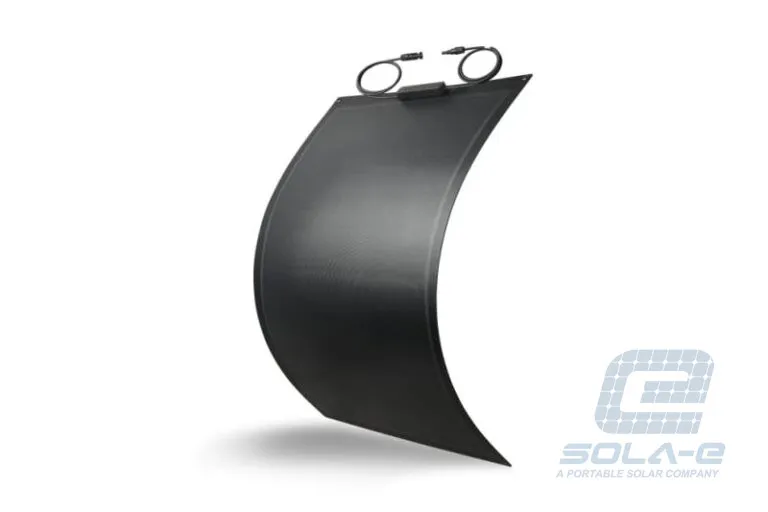
Whether you are speccing panels for an RV model line or building kits for upfitters, the sizing logic is the same. Start from the energy the vehicle uses each day, then work back to watts and roof space.
1. Add up daily energy use
List every DC and AC load and estimate watt-hours (Wh) per day: power × hours of use. A typical list for a camper might include a 12 V fridge, lights, a water pump, a fan, phone and laptop charging, and sometimes an inverter for small appliances.
The fridge usually dominates, because it runs around the clock. Use the manufacturer’s average daily consumption rather than its peak draw.
2. Convert to solar watts
Divide daily Wh by the peak sun hours where the RV is used, then allow for real-world losses from heat, dirt, shading, wiring and charge-controller efficiency. A simple working formula:
Solar watts ≈ daily Wh ÷ peak sun hours ÷ 0.75
For example, 1,200 Wh a day with 4.5 peak sun hours needs roughly 1,200 ÷ 4.5 ÷ 0.75 ≈ 355 W. Rounding up, that is two 200 W panels.
Panels on a hot roof produce less than their rating, so be conservative with the loss factor in hot climates, and always mount flexible panels with an air gap behind them.
3. Check the roof
Measure the usable roof after vents, hatches, air conditioners and walkways. Then match panel footprints to the space. Our USF HPBC series runs from the 640 × 400 mm (25.2 × 15.7 in) USF-50H to the 1800 × 770 mm (70.9 × 30.3 in) USF-300H, and we make custom sizes from 200 mm (7.9 in) wide up to 2 m (6.6 ft) long for narrow or awkward roofs.
On curved roofs, check the curve against the bending limit for that panel size.
4. Match the charge controller and battery
- Controller. Use MPPT for flexible panels over 100 W. It gets more energy out of the panel than PWM, especially in cold or cloudy conditions.
- Voltage. Check the panel’s Vmp and the controller’s input range. Panels can be wired in series to raise voltage or in parallel to raise current.
- Battery. Size the battery for at least one day of autonomy, more for off-grid use.
5. Plan for the road
An RV panel spends its life vibrating. Choose panels with vibration test data, an ETFE surface, and a structure that spreads stress, and mount them with an air gap behind them. Our guide to why flexible panels fail on RVs covers this in detail.
Need a configuration for your model?
Send us your roof dimensions, target wattage and annual volume. We’ll suggest a panel layout and controller, and send vibration test data with the samples.