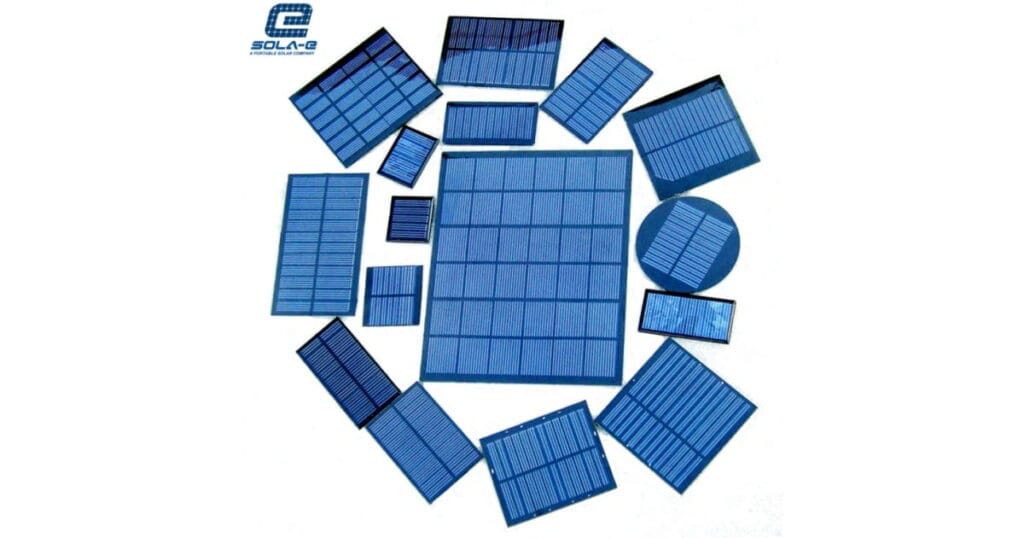
Executive Insight: In the industrial IoT sector, a small solar panel is not just a component; it is the Energy Heart of the system. For 2026, the benchmark for autonomous sensors and smart infrastructure is “Deploy & Forget,” requiring micro-panels that balance high-efficiency cells with industrial-grade ETFE lamination.
1. The Technology Behind Industrial Micro-Solar
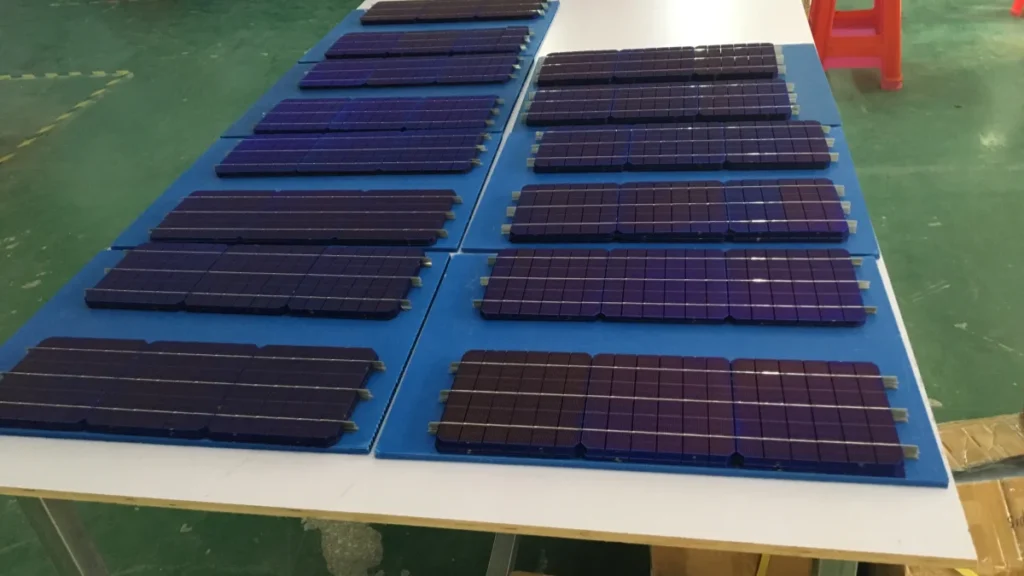
Most “small panels” on the market are consumer-grade toys using PET lamination. For B2B applications, Sola-E re-engineered the micro-panel using the same 12-step QC standards as our 200W arrays.
The ETFE Advantage
Unlike PET, which yellows and cracks within 12 months of UV exposure, our integrated ETFE lamination ensures a 10-year service life. This is critical for agricultural and chemical plant sensors where environmental stress is high.
High-Efficiency Cell Integration
By using Back-Contact cells, we achieve up to 24% efficiency in a compact footprint. This allows a 1W module to be as small as a postage stamp ($D90 \times 2.0\text{mm}$), ideal for space-constrained IoT housings.
OEM Comparison Table
| Application Type | Recommended Wattage | Key Tech Requirement | Sola-E Edge |
| IoT Sensors | 0.5W – 1W | Ultra-thin / Indoor light | Sb₂S₃ High-Efficiency Cells |
| Smart Lighting | 1.5W – 5W | Weatherproof / High Voltage | Integrated ETFE Lamination |
| Drone Stations | 5W – 20W | High Power Density | Mono Cell Integration |
2. Real-World Case Studies: From Agriculture to Smart Cities
Case A: Smart IoT Environmental Monitoring
Scenario: Remote water quality and soil moisture sensors.
- Scenario: Remote water quality and soil moisture sensors.
- The Challenge: High cost of manual battery replacement in remote areas.
- The Sola-E Solution: A 1W ETFE panel providing a continuous trickle charge to LiFePO4 batteries.
- The Result: 100% autonomy and “Zero-Touch” maintenance for 5+ years.
Case B: 1W & 1.5W Solar Lawn Lighting Upgrade
Scenario: Community park lighting renovation to eliminate trenching costs.
- The ROI: Replaced 220V AC systems with 3.2V DC solar lamps, saving $1,500/year in energy and eliminating electrical shock risks.
- Engineering Note: Integrated light sensors trigger automatic dusk-to-dawn operation without external controllers.
⚠️ The “Micro-Component Trap”: Why Projects Fail
In B2B sourcing, a $5 solar panel can be the single point of failure for a $500 IoT device.
- Mistake 1: PET Delamination. Cheap PET panels absorb moisture, leading to internal corrosion in 6-18 months.
- Mistake 2: Poor Voltage Matching. Many off-the-shelf panels don’t match the 3.2V/3.7V charging curves of modern lithium batteries, leading to an Energy Gap Risk.
- Mistake 3: Structural Fragility. Without industrial-grade backing, small panels crack during product assembly (OEM press-fitting).
Small Solar Panel Applications: Frequently Asked Questions
Q1: What is the real-world lifespan of an ETFE-laminated small solar panel?
A: While cheap PET-coated panels typically yellow and delaminate within 6-12 months, our ETFE-laminated micro-panels are engineered for a service life of 5 to 10 years. ETFE is a high-grade industrial fluoropolymer that is UV-stable and self-cleaning, making it the standard for mission-critical IoT deployments in harsh outdoor environments.
Q2: Can the solar panel dimensions be customized to fit my specific device housing?
A: Absolutely. We specialize in Custom DFM (Design for Manufacturability). We can tailor the shape (circular, rectangular, or irregular), adjust the voltage output (e.g., optimized for 3.2V LiFePO4 or 3.7V Li-ion systems), and reposition solder pads to ensure the panel integrates seamlessly into your product casing without structural interference.
Q3: Why are cells preferred for micro-solar IoT sensors?
A: Back-Contact cells offer efficiency up to 24%, which is significantly higher than standard monocrystalline cells. In small-scale applications, this translates to a superior “Energy-to-Size” ratio. You can harvest more power from a smaller surface area, which is essential for compact wearables and miniature environmental sensors.
Q4: Are these small solar modules durable enough for smart city infrastructure?
A: Yes. Our panels achieve an IP65 to IP67 waterproof rating through a high-pressure vacuum lamination process. This eliminates the risk of water ingress and internal corrosion. They are tested to operate in extreme temperatures ranging from -30°C to +80°C, ensuring reliability for smart streetlights and urban monitoring networks.
Q5: How does a small solar panel prevent the “Energy Gap Risk” in IoT devices?
A: The Energy Gap Risk occurs when a device’s daily consumption exceeds its solar intake. By using high-efficiency ETFE panels, we ensure a higher energy harvest even in low-light conditions. This provides a consistent “trickle charge” to the battery, eliminating the need for manual battery replacements and ensuring 24/7 autonomous operation.
The Engineering-Grade CTA
Get Your Custom Micro-Solar Prototyping Proposal
Small panels require big engineering. Our technical team supports DFM (Design for Manufacturability) to ensure our panels fit your device housing perfectly.
Submit your specs to receive:
- ✅ Custom Voltage & Size CAD Drawings (optimized for your casing).
- ✅ Battery Matching & MPPT Efficiency Analysis for autonomous IoT.
- ✅ ETFE vs. PET Durability Comparison Report (real-world aging data).
*Free technical evaluation for OEM & Product Design Teams.
Sam | Solar Application Specialist
With over 10 years of experience in the photovoltaic manufacturing industry, Sam specializes in risk control and application engineering for portable battery chargers and marine solar panel solutions. He helps OEMs and distributors bridge the gap between technical specs and real-world performance.