Ever walked past a row of solar panels and thought, “They look fine to me”?
I used to think the same thing. They just sit there, soaking up the sun, right? But looks can be deceiving. A panel can look crystal clear while its internal “nervous system” is failing. If you want to know if your system is actually healthy, you need more than just a quick glance.
01. The 30-Second “Field Health” Check
When I’m out in the field, I look for three specific red flags. Think of this as a quick physical for your solar array:
- Surface Browning: Also called “snail trails.” These dark, wavy lines mean moisture is leaking in.
- Delamination: Like a bad sunburn where layers peel away. If you see bubbles, the hermetic seal is gone.
- Voltage Drop Analysis: The most honest test. Use a multimeter to check output. If it’s significantly lower than the label, you have an internal “clog.”
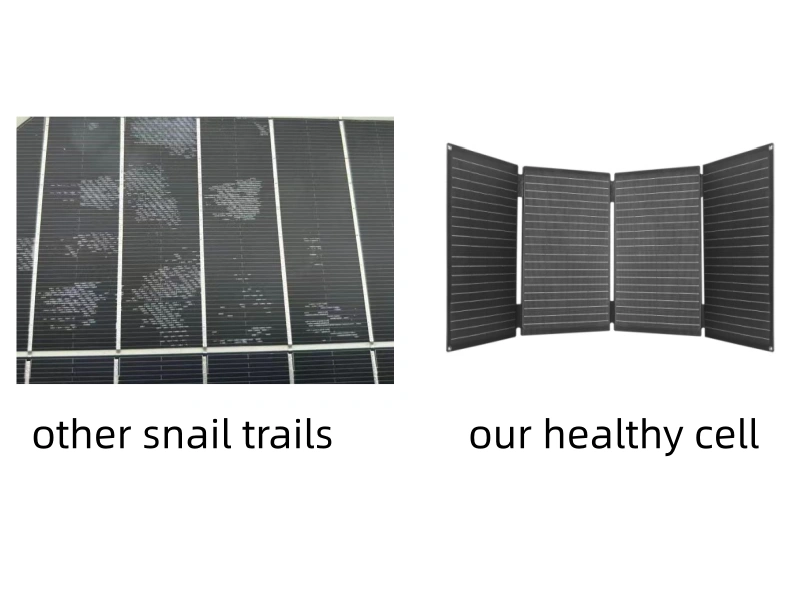
02. The “Invisible Killer”: Micro-cracks
The biggest threat to your ROI is something you can’t see: micro-cracks. These tiny fractures in the silicon cells are caused by heavy snow, hail, or even someone walking on the panels. To the naked eye, they are invisible. But under an infrared camera, they glow like hot embers. Once those cracks spread across the conductive path, electricity starts rerouting around damaged areas like traffic avoiding a collapsed bridge.
According to NREL research, micro-cracks can contribute to significant annual power loss in photovoltaic systems, especially in mechanically stressed deployments.
Over time, even minor cell fractures can reduce energy yield, increase hotspot formation, and shorten operational lifespan. To prevent this, we focus on Anti-crack technology in our manufacturing process.
03. The $5,000 “Truck Roll” Math
In the B2B world, we don’t just buy hardware; we buy predictability. A failed $500 panel rarely costs just $500. If it dies at a remote site, you pay for a technician, a truck, fuel, and lost time. By the time that “truck roll” is done, you’ve spent $5,000 on a single failure.
| Failure Type | Hardware Cost | Logistics & Labor | Downtime Loss | Total Impact |
| Micro-Crack (Slow) | $500 | $800 | $1,200 | $2,500 |
| Total Panel Failure | $500 | $1,200 | $3,300 | $5,000 |
| Connector Corrosion | $20 | $1,000 | $1,500 | $2,520 |
For mission-critical projects, investing in high-efficiency portable solar panels is the only way to lower your LCOE (Levelized Cost of Energy).
04. Engineering Section: The “Hinge Trap”
Flexibility has limits. If you bend a panel too far (a 180° hard fold), you hit the Hinge Trap. This concentrates all the stress on the busbars, causing them to snap.
At Senior Solar, we solve this with a Stress-Relief Bridge. It’s a reinforced bending radius that gently disperses pressure. We also avoid “Decorative Stitching”—which is a moisture trap—and use structural thermal-bonding. This is why our marine solar panels survive where others rot.
05. The 2026 Procurement Compass
Different deployment environments demand different material architectures. Pick the right “recipe” for your environment:
- Marine: TOPCon-F + POE (5–8 yrs). POE encapsulation performs significantly better in high-salinity deployments due to its superior moisture resistance.
- Desert: HJT + ETFE Composite (6–10 yrs). HJT cells handle heat best because they have a superior temperature coefficient.
- Mobile Fleet: N-Type + Fiberglass (4–6 yrs). Vibration is the killer; fiberglass is the skeleton.
Explore our Custom OEM solar solutions to match your specific climate.
06. Field Maintenance: The “PVSyst” Guard
To make sure your PVSyst simulations match reality, you need a Field SOP:
- Deionized Water Only: Tap water leaves mineral scales. Scaling creates hot spots.
- Dielectric Grease: Apply to MC4 connectors to pass IEC 61701 Grade 6 salt mist tests.
- Vertical Storage: Never stack panels flat. The pressure causes PID (Potential Induced Degradation).
07. Case Study: 48-Month ROI
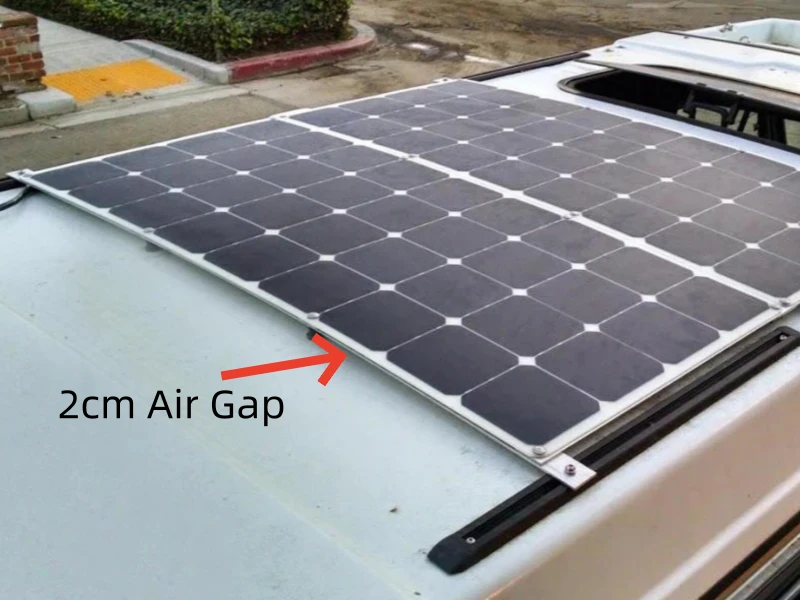
We helped a remote sensing fleet extend their asset lifespan from 14 months to 48 months. By switching to ETFE + POE builds and using proper air-gaps, they cut their maintenance budget by 22%. You can see our factory direct B2B guide for the full breakdown of these savings.
08. Engineering FAQ: Durability & Maintenance
Q1: Why do foldable solar panels typically have a shorter lifespan than rigid panels?
While rigid solar panels are built with tempered glass and heavy aluminum frames designed for decades of stationary operation, foldable modules prioritize portability and weight reduction. This mobility introduces a different engineering trade-off.
The primary challenge isn’t the sun—it’s mechanical fatigue. In a rigid setup, components never move. In a foldable setup, repeated folding cycles place microscopic stress on internal busbars and conductive pathways.
At Senior Solar, we don’t aim to mimic the static lifespan of a 40-pound glass slab. Instead, we focus on maximizing the duty cycle of flexible modules through reinforced bending-radius engineering and anti-crack structural layers. This ensures our panels survive the rigors of the field where traditional rigid panels simply cannot be deployed.
Q2: Can foldable solar panels withstand long-term outdoor exposure in rain?
High-quality panels with IP67/IP68-rated junction boxes and thermally bonded construction are designed for outdoor durability. However, cheaper “stitched-edge” panels allow for gradual moisture ingress. In high-humidity or marine environments, moisture intrusion accelerates connector oxidation and internal corrosion, leading to voltage instability. We recommend thermally bonded edges and periodic application of dielectric grease for any permanent outdoor deployment.
Q3: What is the most common storage mistake for portable solar panels?
The most common error is horizontal stacking under load pressure. When panels are stacked flat like pancakes, the cumulative weight creates localized stress points on the lower modules. This pressure generates invisible micro-cracks around folding zones and busbar intersections. To prevent stress-related degradation, modules should always be stored vertically in a dry, temperature-controlled environment.
Q4: Why is my solar panel turning brown or yellow over time?
This is typically a sign of EVA degradation. Many retail panels use Ethylene Vinyl Acetate (EVA) as an encapsulant, which breaks down under intense UV exposure and high thermal buildup, causing a “browning” effect that blocks light. To solve this, we utilize POE (Polyolefin) encapsulation, which is chemically stable and remains 100% clear regardless of UV intensity or heat.
Q5: What causes “hot spots” in portable solar panels?
Hot spots occur when a cell’s current is restricted—often by partial shading, bird droppings, or internal micro-cracks. The restricted cell becomes a resistor, generating intense heat that can melt the backsheet. We reduce hot spot risks by using high-count busbar (12BB+) designs, providing multiple redundant paths for electricity to flow around obstructions.
Q6: Are ETFE panels significantly better than PET panels?
Yes, specifically for industrial use. PET (Polyethylene Terephthalate) is a cheap plastic that delaminates and scratches easily. ETFE (Ethylene Tetrafluoroethylene) is a high-strength, self-cleaning fluoropolymer. It is highly resistant to UV radiation and thermal stress, offering a lifespan 3–4 times longer than PET in harsh environments.
Q7: How often should MC4 connectors be inspected in the field?
For industrial or marine deployments, we recommend a semi-annual inspection. Check for signs of thermal deformation or salt-mist corrosion. Passing IEC 61701 Grade 6 salt-mist standards requires a hermetic seal; if the O-ring appears dry or cracked, re-apply dielectric grease to maintain connector integrity.
Q8: What is the safest bending radius for flexible solar panels?
Every flexible panel has a “minimum bend radius” to prevent cell fracture. While some claim extreme flexibility, a safe engineering limit is usually a 30-degree arc. Pushing toward a 180-degree “hard fold” concentrates mechanical stress on the silicon cells. Our Stress-Relief Bridge ensures that even during movement, the cells remain within their safe elastic deformation range.
Don’t Just Buy a Panel—Invest in a Predictable Future
Generic hardware fails in extreme environments. Senior Solar provides B2B clients with Lifespan Simulations and DFM Analysis to ensure your power plant survives the field.
* Engineering First: You will be contacted by a Senior Project Engineer, not a sales representative, within 24 hours.
Sam | Solar Application Specialist
With over 10 years of experience in the photovoltaic manufacturing industry, Sam specializes in risk control and application engineering for portable battery chargers and marine solar panel solutions. He helps OEMs and distributors bridge the gap between technical specs and real-world performance.