When sourcing at scale, a datasheet is just a promise. Real performance is determined on the factory floor. At Senior Solar, we don’t just “assemble” panels; we engineer them for zero-failure field operations. This guide is designed for procurement teams and engineers who need long-term reliability—not the lowest upfront price.Most buyers come to this page after realizing that poor design or undersized panels lead to system failure.
Here is a transparent look at our 2026 manufacturing workflow—and why typical suppliers fail where we succeed.
Table of Contents
Stage 1: The Integrated Lamination “Armor”
Most field failures—like peeling, bubbling, or water ingress—start with poor lamination. Many “market-grade” suppliers still use stitched fabric because it’s cheaper and faster to produce.
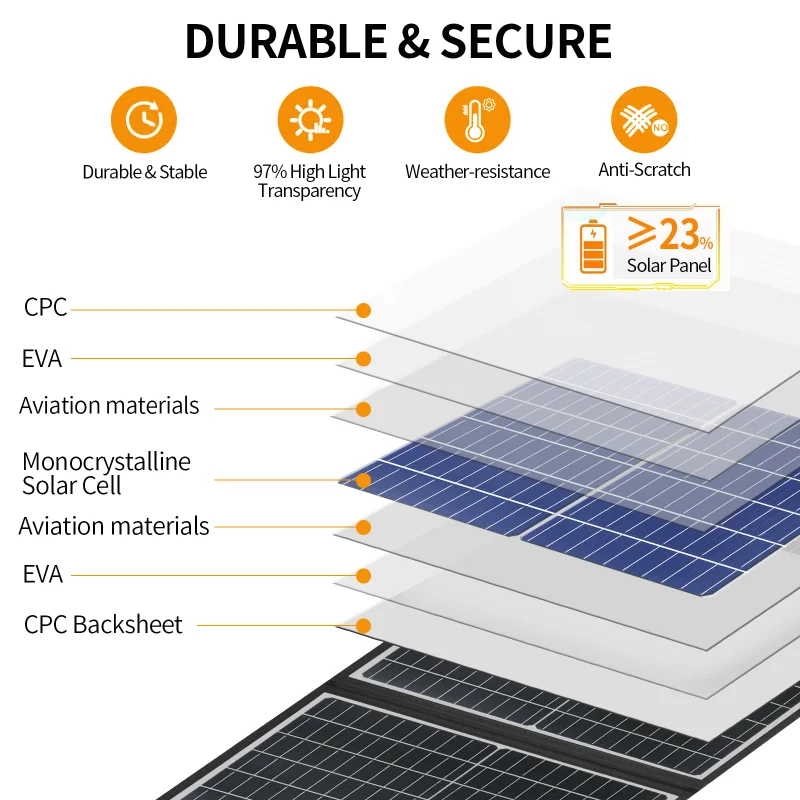
We use Integrated Vacuum Lamination. This 5-layer stack (ETFE / EVA / Cells / EVA / CPC) is bonded under high-temperature vacuum to create a 100% airtight seal.
Comparison: Engineering vs. Market-Grade Panels
| Key Factor | Typical Supplier | Our Factory |
| Lamination | Stitched / Semi-laminated | Full Vacuum Lamination |
| Fold Cycles | 200–300 cycles | 1,000+ Cycles Tested |
| QC Process | Random Sampling | EL + IV Testing |
| Defect Rate | 3% – 5% | < 0.8% |
| Moisture Protection | Limited (Stitched) | Fully Sealed (IP67) |
⚠️ A 20% lower purchase price often leads to 200% higher maintenance costs within the first year.
Stage 2: The “Flexible Bridge” Engineering
The “fold” is the most vulnerable part of any portable panel. This is where most foldable solar panel factory shortcuts happen.
⚠️ The Real Cost of a “Cheap” Hinge
A single panel failure in the field isn’t just a minor annoyance. For a B2B project, it leads to:
- Full system downtime and data loss for weeks.
- Expensive maintenance trips to remote locations.
- Client contract penalties due to power failure.
We solve this with Flexible Bridge Technology. We leave a precise, engineered gap between cells and use high-fatigue copper wiring. This ensures the panel survives 1,000+ fold cycles without internal snapping.
Stage 3: 12-Step QC (The Trust Verification)
In B2B sourcing, trust is verified by data, not adjectives. Every batch at our facility undergoes a rigorous 12-step verification protocol to ensure your field operations never go dark. Each stage is designed to eliminate a specific category of failure:
I. Pre-Production: Component Grading
- Cell Sorting & Grading: We use only A-Grade monocrystalline cells. Any cell with even a slight color deviation or micro-nick is rejected.
- Material Compatibility Check: We verify the UV-resistance index of the ETFE and the bonding strength of the EVA film for every incoming batch.
II. In-Process: Real-Time Monitoring
- Precision Laser Cutting: Cells are cut to size with micron-level accuracy to prevent edge stress.
- Stringing Inspection: We visually and electronically check the soldering of the “flexible bridges” before lamination.
- Lay-up Alignment: Ensuring the cells are perfectly centered to prevent “shading hotspots” at the hinges.
- Lamination Parameter Control: Real-time monitoring of vacuum pressure and temperature curves to prevent air bubbles.
III. Post-Lamination: The “Hard” Tests
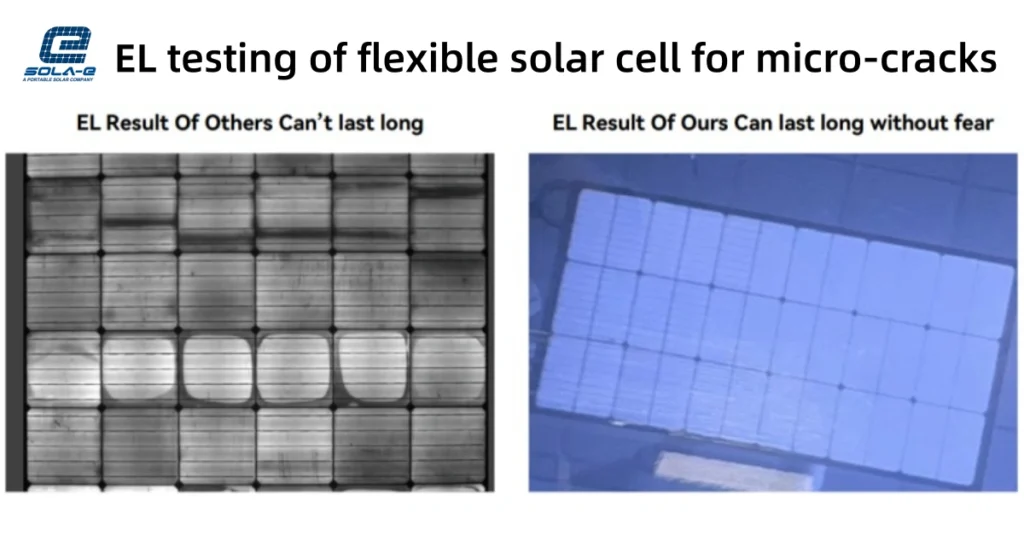
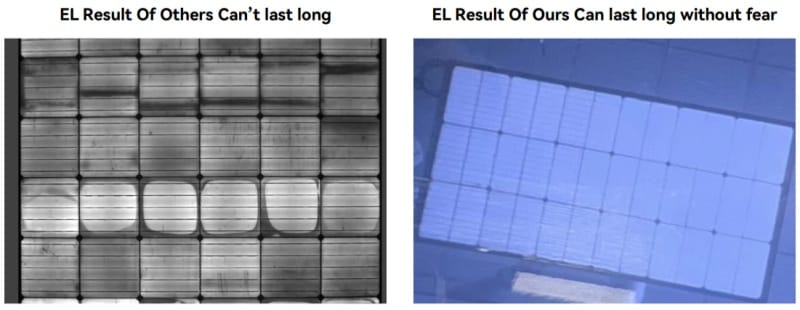
- 100% EL Testing (The X-Ray): This is our “secret weapon.” It reveals hidden micro-cracks inside the silicon that the human eye cannot see. We scan every single panel after it leaves the laminator. Electroluminescence (EL) testing is widely used in the photovoltaic industry to detect hidden micro-cracks (as defined by National Renewable Energy Laboratory).

- IV Curve & Power Verification: We don’t “claim” wattage — we verify it using IV curve testing under a solar simulator. This ensures each panel meets its real Voc, Isc, and Pmax specifications before shipment. According to PV performance modeling research (OSTI), IV curve testing is the industry-standard method for validating real-world solar output. 👉 Learn more about PV I-V modeling (OSTI)
- High-Pot Insulation Test: We apply a high-voltage surge to ensure the panel’s insulation is perfect and there is zero leakage risk. This is critical for outdoor deployments where humidity and rain can cause leakage or safety failures.
IV. Final Reliability Audit
10. Final Kit Functionality: We test the actual USB-C PD or MC4 output with a load to ensure the “brain” of the panel is working perfectly.
11. Mechanical Fold Test: Random samples from each batch undergo a 1,000-cycle mechanical fold test to verify hinge durability.
12. Visual “Aesthetic” Audit: Checking for edge sealing, junction box adhesion, and surface clarity.
This is why our panels maintain stable performance after years in the field, while low-cost alternatives often fail within months.
Factory Capability Snapshot
Reliability means being able to deliver at scale.
- Annual Capacity: 50MW+
- Tested Fold Cycles: 1,000+ (No power drop)
- Factory Defect Rate: < 0.8% (2025 Audit)
- Lead Time: 7-day prototyping / 25-day mass production.
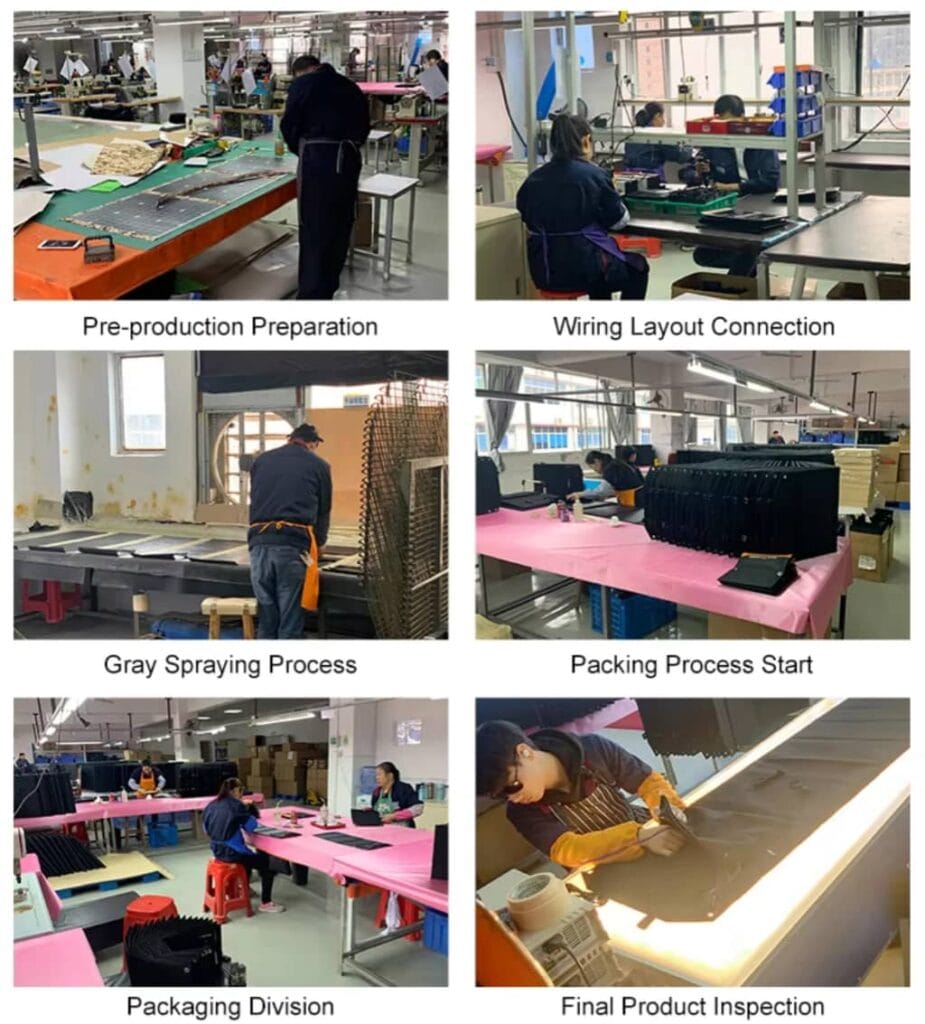
Common Factory & Sourcing Questions
Q1: Can you handle custom sizes and unique folding shapes (OEM)?
Yes. As a direct foldable solar panel factory, we own our lamination molds and CAD design software. We can customize the dimensions, junction box placement, and the number of folding sections to fit your specific equipment or vehicle housing.
Q2: What is the typical lead time for a wholesale order?
For standard models, we maintain a rolling stock. For custom OEM solutions, our typical timeline is:
7–10 days for functional prototyping.
25–30 days for mass production (depending on order volume).
Q3: Do you provide EL and IV test reports with every shipment?
Absolutely. We believe in “Trust but Verify.” Every bulk order comes with a Digital Quality Passport including the EL (X-ray) scans for micro-cracks and the IV curve performance data for every panel. This ensures you receive exactly what you paid for.
Q4: How do you ensure the panels won’t delaminate in marine environments?
Most failures happen because of “stitched” edges. We use Integrated Vacuum Lamination, which seals the solar cells in a 100% airtight “sandwich.” Combined with high-grade ETFE surfaces, our panels are salt-mist resistant and IP67 waterproof.
Q5: What is your real-world defect rate (RMA)?
Based on our 2025 internal audit, our factory-level defect rate is less than 0.8%. We achieve this through 100% automated testing during the lamination and assembly phases, ensuring that problematic units never leave our facility.
Conclusion: Get Verified Before You Order
Choosing a specialized foldable solar panel factory is about risk control. Before placing a bulk order, you must verify your supplier with real engineering data.
Already decided between 100W and 200W? Now verify the quality before ordering.
High-Value CTA: Get Your Factory Audit Package
Sam | Solar Application Specialist
With over 10 years of experience in the photovoltaic manufacturing industry, Sam specializes in risk control and application engineering for portable battery chargers and marine solar panel solutions. He helps OEMs and distributors bridge the gap between technical specs and real-world performance.