
Solar power bank vs foldable solar charger: charging speed, weight and best uses
A worked example: a 20,000 mAh power bank with a 6 W built-in panel vs a 25 W foldable charger. How long each takes to refill the battery, what each weighs, and when to choose which.
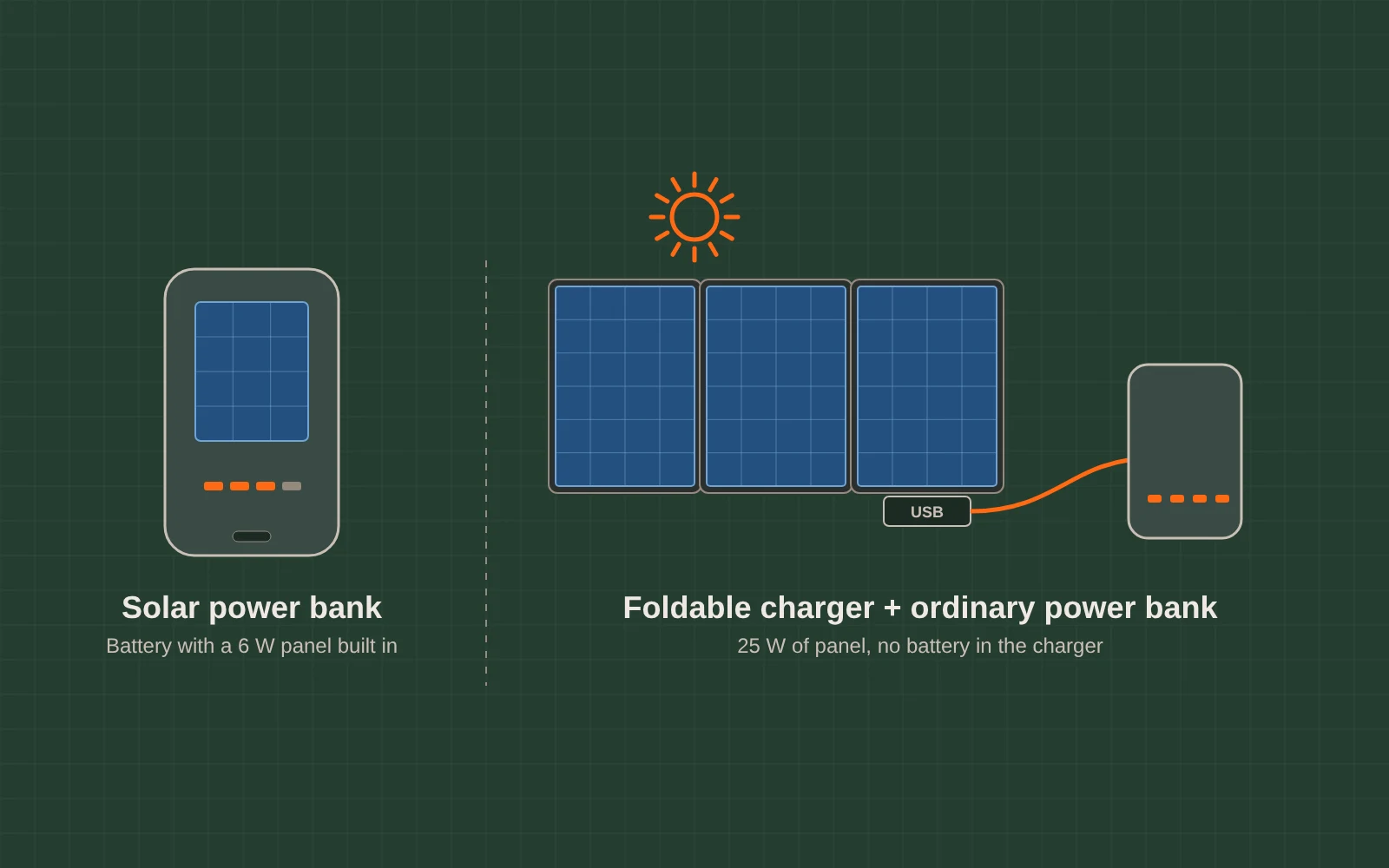
Short answer: a solar power bank is a battery with a small panel built in. A low-power built-in panel is better suited to topping up than to refilling the battery quickly, so most charging still comes from the wall. A foldable solar charger has no battery, but its larger panel area usually gives much more solar input. For trips of more than a day or two, a foldable charger used with an ordinary power bank refills faster; for day trips, a solar power bank is simpler.
The figures below are calculated examples with stated assumptions, not test results for any particular product.
What’s inside each
| Comparison | Solar power bank | Foldable solar charger |
|---|---|---|
| What it is | A battery with a built-in panel | A folding panel with USB ports, no battery |
| Panel power in this example | 6 W | 25 W (our UT25H) |
| USB output | From the battery | 5 V / 3 A from the panel (UT25H) |
| Charges a phone at night | Yes, from its battery | No |
| Main job | Stored power | Collecting solar power |
Example: refilling a 20,000 mAh power bank
A 20,000 mAh power bank stores about 74 Wh (20,000 mAh at the battery’s 3.7 V). We count in watt-hours because they compare cleanly across different voltages. Charging and conversion losses still apply, so we assume 85% of the input reaches the battery.
| Assumption and result | 6 W built-in panel | UT25H foldable charger |
|---|---|---|
| Assumed average power into the power bank in steady sun | About 4.5 W (5 V, 0.9 A) | 10–12 W (port limit 15 W) |
| Power reaching the battery (85%) | About 3.8 W | About 8.5–10 W |
| Hours of full sun to refill 74 Wh | About 19–20 | About 7.5–9 |
Both columns end at the same place: energy stored in the 20,000 mAh battery. Twenty hours of full sun is four or more sunny days, because a day has only a few hours of strong, direct sun.
Example: one full phone charge
A large phone battery holds about 21 Wh. The iPhone 18 Pro Max, for example, has a 5,391 mAh battery, as reported by MacRumors. Both routes below end with the phone full. For the power bank route, we also assume that 85% of the energy stored in the power bank reaches the phone battery.
- Built-in 6 W panel, then from the power bank to the phone: about 6.5 hours of full sun to collect enough energy, after losses on the way into the battery and on the way out to the phone.
- UT25H plugged straight into the phone: about 2–2.5 hours of strong, steady sun. Phones slow down near full, and a passing cloud pauses charging.
Clouds, a low sun or a panel that isn’t facing the sun add time to both.
Weight
In this example, the solar power bank’s listed net weight is 618 g (1.36 lb). Including cables and accessories, we estimate a carrying weight of around 0.7 kg (1.5 lb). The UT25H weighs 0.42 kg (0.93 lb) and the UT15H 0.3 kg (0.66 lb), but neither has a battery, so on a multi-day trip you carry one with an ordinary power bank. Compare the full kits for the products you’re considering: the panel, the power bank and the cables you’d carry.
When a solar power bank makes sense
- No sun at all. At night or under heavy cloud, the battery keeps charging your phone.
- Day trips. If you’ll be home tonight, the battery does the work and the panel size matters little.
- One thing to carry. It’s simpler, and often cheaper.
When a foldable charger makes sense
- Several days away from a wall socket. The larger panel refills a power bank in a fraction of the time.
- Faster charging in good sun. Models from 30 W add USB-C PD output.
- You already own a power bank. The panel adds charging capacity without a second battery.
The setup that works on longer trips
Open the foldable charger in the sun and charge an ordinary power bank from it during the day. Charge your phone from the power bank whenever you need to, day or night. The power bank also smooths out passing clouds.
For power bank and outdoor brands
A foldable charger can be offered alongside a power bank as a kit, for customers who spend several days off-grid. Our UT foldable chargers (15–80 W, IP67 laminated) come with your logo and retail box from 50 pieces. See the solar chargers and hiking and backpacking pages.
FAQ
Can I charge my phone straight from a foldable charger? Yes. In steady sun it works well. When a cloud passes, the output drops and some phones stop charging, so a power bank in between is more reliable.
Does a fold-out panel on a power bank help? Yes, more panel area means more input. Compare the unfolded panel’s rated power and size, not the battery capacity printed on the box.
What size foldable charger should I choose? 15–25 W for phones, headlamps and GPS units. 30–45 W with USB-C PD if you also charge a larger power bank or a tablet.