
How long do RV solar panels last? Three lifetimes that don't match
An RV panel can physically last 15–20 years, outlive a 5-year warranty, and still be outgrown by the RV's power needs sooner. How physical, warranty and useful life differ.
When people ask how long the rv solar panels last, the conversation usually starts with degradation.
How much power will it still make after 20 years? Or 25?
That’s a fair question for a panel bolted to a fixed house roof. A U.S. National Renewable Energy Laboratory review of nearly 2,000 field measurements found a median degradation rate of about 0.5% per year for flat-plate modules.
An RV is a different story. The panel has to survive electrically, but it also has to stay mechanically sound, keep working with the vehicle’s energy system, and earn its place on a very small roof.
So I find it more useful to ask a broader question:
How long will this panel stay the right panel for this vehicle?
Quick Answer: What Does “Lifetime” Mean for an RV Solar Panel?
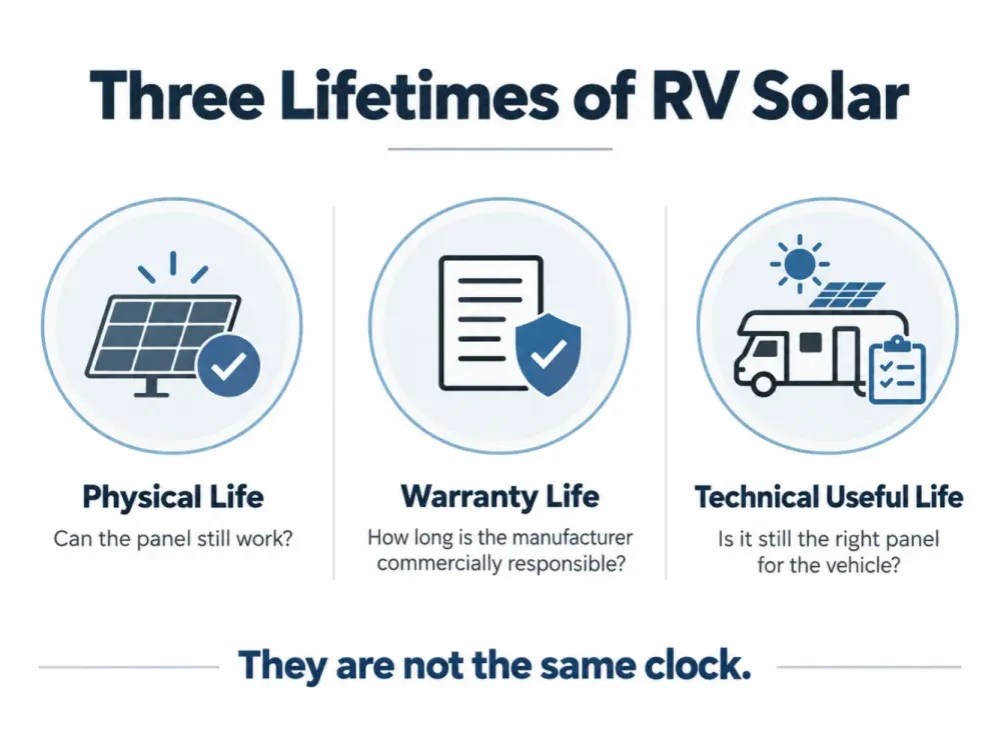
An RV solar panel has three different lifetimes, and they don’t match.
- Physical life: how long the whole panel assembly keeps working under heat, vibration, and movement.
- Warranty life: how long the manufacturer is commercially responsible for it.
- Technical useful life: how long it remains the right solar solution for the vehicle’s energy needs and roof space.
A panel can outlast its warranty. It can also outlast its usefulness. Treating all three as one number is where buyers and product teams often go wrong.
1. Physical Life: Can the Panel Still Work?
This is the lifetime most people picture.
For an RV panel, physical life depends on whether the entire assembly keeps working after years of:
- heat and UV exposure;
- moisture;
- vibration and vehicle movement;
- repeated thermal cycling;
- flexing or structural movement;
- stress around junction boxes, cables, and bonded interfaces.
A panel on a moving vehicle isn’t the same as a rigid glass module on a fixed roof. It’s part of a moving product.
So the question isn’t only whether the cells can still make electricity. It’s whether everything around them is still holding together.
The laminate can look fine while a cable exit gets weaker. The cells can keep producing while the bond starts to let go. A panel can pass one lab test and behave differently on a hot, vibrating roof. We looked at several of these failure points in our guide to thermal management for flexible RV solar panels.
Physical life matters a lot. But it’s only the first clock.
2. Warranty Life: How Long Is the Maker Commercially Responsible?
Warranty life and design life are easy to mix up. They aren’t the same thing.
A five-year warranty doesn’t mean a product is built to fail in year six. It means the manufacturer has set a five-year period of commercial responsibility, under specific conditions.
You can see this in the flexible and mobile solar market. One well-known retail brand, for example, lists a 5-year product warranty and a 5-year output warranty on a 100W flexible panel, with at least 90% of output maintained within that period. That’s a very different structure from the 20- or 25-year terms common on stationary rooftop panels.
It would be wrong to read this as “five years is enough.”
The better reading is simple: warranty life is not physical life. And neither one tells you how long the panel will stay the right choice for the RV.
3. Technical Useful Life: Is It Still Worth Keeping on the Roof?
This is the clock that gets the least attention.
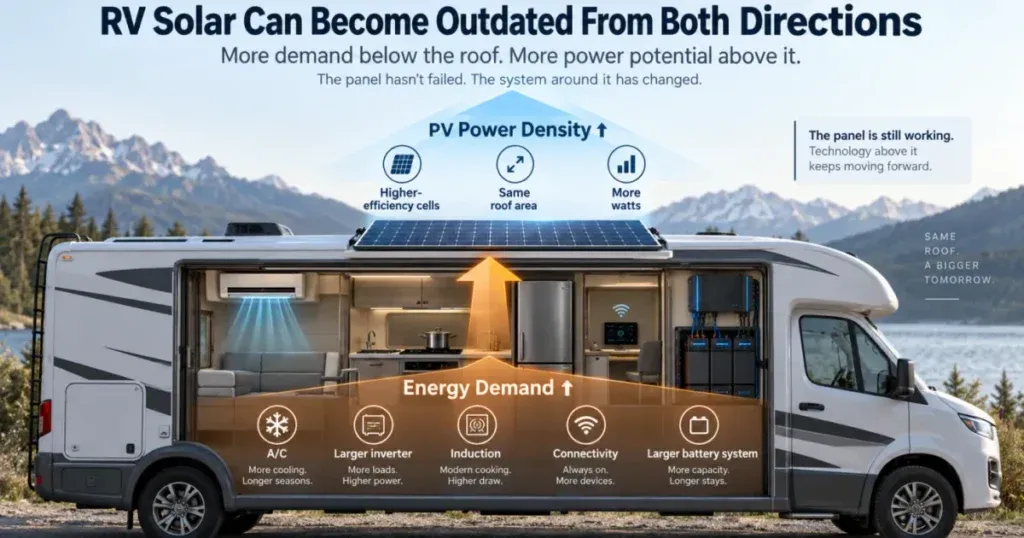
A panel can work perfectly and still become less valuable to the vehicle. Two things can cause that, one from below the roof and one from above it.
Demand-side aging: the RV starts asking for more
Picture a simple RV system. The solar mostly runs lights, a fridge, a water pump, and device charging. A few hundred watts feels like plenty.
Then the RV changes. The owner adds a bigger lithium battery bank. A larger inverter goes in. Then come Starlink, induction cooking, and, most importantly, air conditioning for off-grid use.
The original panel hasn’t done anything wrong. It may still make almost exactly what it used to.
But the job got bigger.
Say an RV starts with 400W of solar and light loads. Years later, it has the same 400W array, a larger battery, a 3kW inverter, and regular air conditioning. Did the panel degrade badly? Probably not. Is the solar system still enough for the vehicle? Quite possibly not.
That’s technical aging, with no physical failure at all. It’s the same idea behind a point we made in our piece on multi-source RV charging: 400W is a solar specification, not an energy architecture.
Supply-side aging: the same roof space gets more valuable
Now look from the other direction. PV technology keeps moving.
Industry roadmaps show the shift clearly. The ITRPV report, summarized by pv magazine, says n-type TOPCon technology now leads the market for the first time, overtaking p-type PERC.
Higher-end modules are pushing efficiency further. As one illustration, LONGi’s Hi-MO 9 Prime, launched at Intersolar Europe in June 2026, reaches up to 25.2% module efficiency. That’s a utility-scale module, not an RV product. I mention it only to show how quickly power density keeps improving.
Why does this matter on an RV? Because the roof isn’t unlimited. It has to share space with air conditioners, vents, skylights, antennas, hatches, and service access.
Every square meter of usable solar area has value. When efficiency improves, the same area can produce more power. So an older panel can keep working perfectly while the cost of keeping it grows.
The panel hasn’t failed. The value of the roof space has changed.
On an RV, efficiency isn’t only about making more energy. It’s about using a scarce surface well. You can read more about the cell technologies behind these gains on our solar cell technology page.
4. RV Solar Can Age From Both Directions
Put the two sides together.
- Below the roof: the vehicle may start needing more energy.
- Above the roof: newer PV technology may offer more power from the same area.
Energy demand can rise below the roof while PV power density improves above it. The panel hasn’t changed, but the system around it has.
The original panel can stay healthy through all of it. Its warranty may be valid. Its degradation may be fine.
But the vehicle may now need something different.
That’s what I mean by technical useful life. It doesn’t end when the panel stops working. It ends when keeping the existing panel is a weaker use of the roof than the alternatives. That can happen because:
- the RV needs more energy;
- the battery system has grown;
- the charging architecture has changed;
- or a newer panel can deliver meaningfully more power from the same area.
5. So Where Does a 25-Year Warranty Fit?
A 20- or 25-year performance warranty still has value. It signals confidence in degradation performance. It can reassure buyers and help with resale. For some product categories, it’s exactly the right message.
But for RV solar, I don’t think it should automatically be the most important lifetime number.
The more useful question may not be:
“Will this panel still make power after 25 years?”
It may be:
“Will this still be the right use of this roof space years from now?”
A panel can physically last 15 or 20 years. But what if the vehicle outgrows its power level in five? Or three? That doesn’t mean the panel was poor quality. It may just mean the RV’s needs and the available technology moved faster than the panel aged.
6. A Better Target for RV Solar Product Teams
From the product side, I don’t think the goal should be to chase the biggest warranty number.
The goal should be a panel that stays:
- mechanically reliable;
- electrically useful;
- compatible with the vehicle;
- and right for the energy architecture it was designed for.
A good RV panel shouldn’t become the weak point of the vehicle. But a panel that stays alive for 25 years isn’t automatically the best choice for that roof for 25 years.
That’s why I’d ask three questions instead of one:
- Physical life: Can the panel still work?
- Warranty life: How long is the manufacturer commercially responsible?
- Technical useful life: Is this still the right panel for the vehicle?
The third question is the one people discuss least. On an RV, it may be the most interesting.
FAQ: RV Solar Panel Lifespan and Warranty
Q1: How long do RV solar panels last?
It depends on which “lifetime” you mean. Physical life depends on how well the full assembly handles heat, vibration, moisture, and thermal cycling. Warranty life is the period the manufacturer commits to. Technical useful life is how long the panel stays the right fit for the RV’s energy needs and roof space.
Q2: Is a 5-year warranty on a flexible RV solar panel too short?
Not necessarily. A warranty period is a commercial commitment, not a design lifespan. Some flexible panel makers use 5-year terms with a performance guarantee, such as keeping at least 90% of output over that period. It’s worth reading what the warranty actually covers, rather than comparing the number alone.
Q3: Does solar panel degradation matter for RVs?
Yes, but it’s only part of the picture. On an RV, mechanical reliability around the junction box, cable exits, and bonded interfaces can matter as much as the cells’ power loss over time.
Q4: When should I replace or upgrade an RV solar panel that still works?
Consider it when your energy needs have grown, for example with a larger battery, bigger inverter, or air conditioning, or when a newer panel could give you meaningfully more power from the same roof area.
Q5: Do I need a 25-year warranty on an RV solar panel?
A long warranty can show confidence and support resale value. But it doesn’t tell you whether the panel will still suit your vehicle’s energy architecture years from now. Treat it as one signal, not the whole answer.
Planning an RV Solar Product That Stays Useful Longer?
For an OEM RV project, panel lifetime isn’t only a durability question. It’s also about how the panel fits the vehicle’s electrical system today, and how much room that system has to grow.
If you’re developing an RV, campervan, or overlanding platform, send us:
- your target wattage and system voltage;
- your expected loads and how they may grow;
- your available roof area and shading sources;
- your mounting or bonding concept;
- your expected operating environment;
- your target warranty period and annual volume.
Sola-E can review cell layout, electrical configuration, and mechanical design against both today’s needs and your expected upgrade path.
Send us your requirements and we reply within 24 hours.