
How much power does a foldable solar panel lose in cloudy weather? Test data
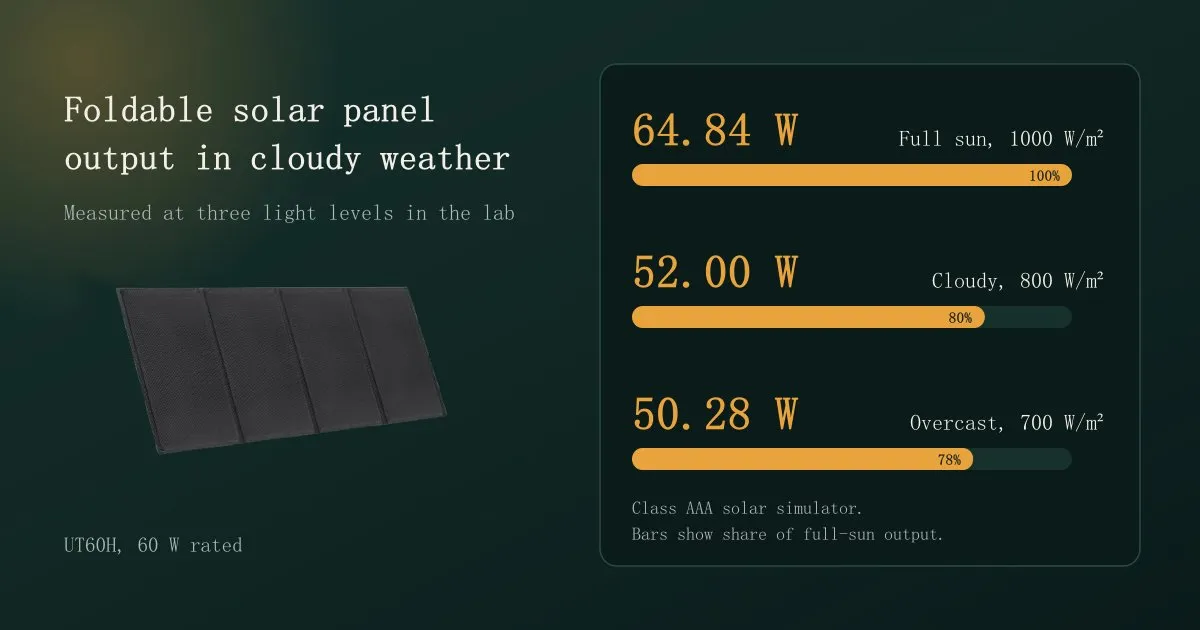
Under haze or thin cloud, our 60 W foldable panel kept 77–80% of its full-sun output in lab tests. Under heavy overcast, expect 10–30%. Test data and IV curves.
Most solar panel spec sheets tell you one number: peak output, measured under perfect sun.
That number is useful. It’s also the least realistic one you’ll ever see in the field.
Real-world use looks different. A cloud passes over. Morning light is weaker than noon light. A tree casts a partial shadow across half the panel. So the question that actually matters isn’t “how much power does this panel make at its best” — it’s “how much power does it still make when conditions aren’t perfect?”
We ran that test on our UT60H foldable panel, and I want to walk through what we found.
Quick Answer
In our laboratory tests, the UT60H foldable solar panel retained:
- 80% of peak power under 800 W/m² conditions
- 77% of peak power under 700 W/m² conditions
- More than 75% fill factor under all test conditions
So under haze or thin cloud, a good foldable panel loses roughly 20–23% of its full-sun output.
Heavy overcast is a different story. Light under thick cloud often falls to 100–300 W/m², and output falls roughly in proportion, to about 10–30% of the rating. Our test did not go that low, so treat that range as a general guide, not a test result.
How We Tested It
We tested the panel using a Class AAA solar simulator, at a controlled temperature of 24–25°C, at three irradiance levels: 1000 W/m², 800 W/m², and 700 W/m².
Here’s what those numbers mean in plain terms. Irradiance is just how much sunlight is hitting the panel per square meter. 1000 W/m² is the industry standard for “full, direct sun at noon.” 700–800 W/m² is closer to a hazy day, thin cloud or mid-morning sun. Thick overcast is much darker, often 100–300 W/m².
We also measured a few specific values at each light level:
- Voc (Open Circuit Voltage): the voltage the panel produces with no load connected
- Isc (Short Circuit Current): the maximum current the panel can push out
- Pmax: the actual usable power output — this is the number that matters most
- Fill Factor: a measure of how “clean” the panel’s power curve is. Higher fill factor means less energy lost internally to resistance
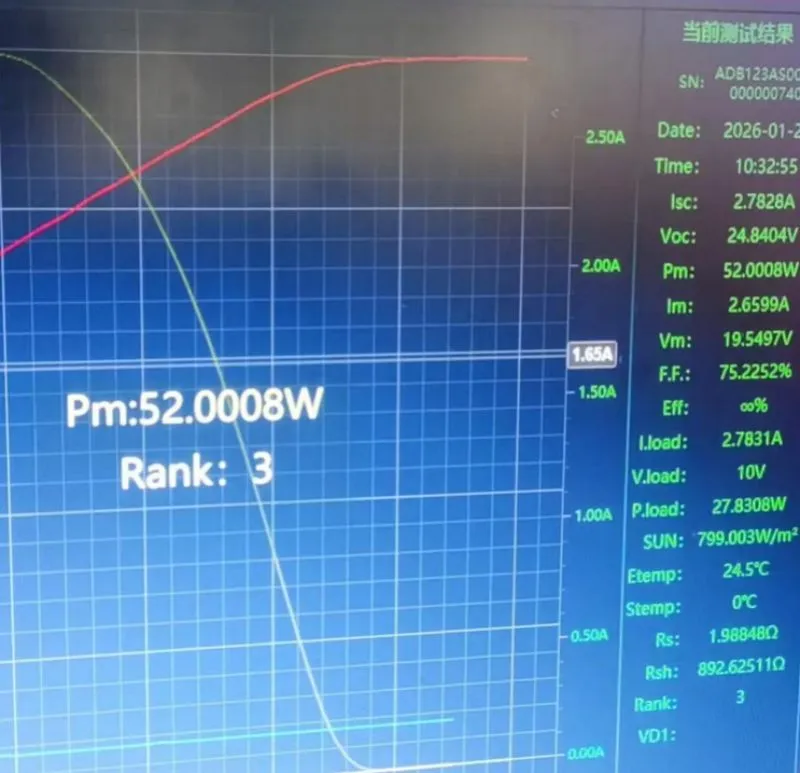
The panel maintained 52.00W under reduced light (800 W/m²) while preserving a 75.22% fill factor.
Full Sun: The Sample Beat Its Rating
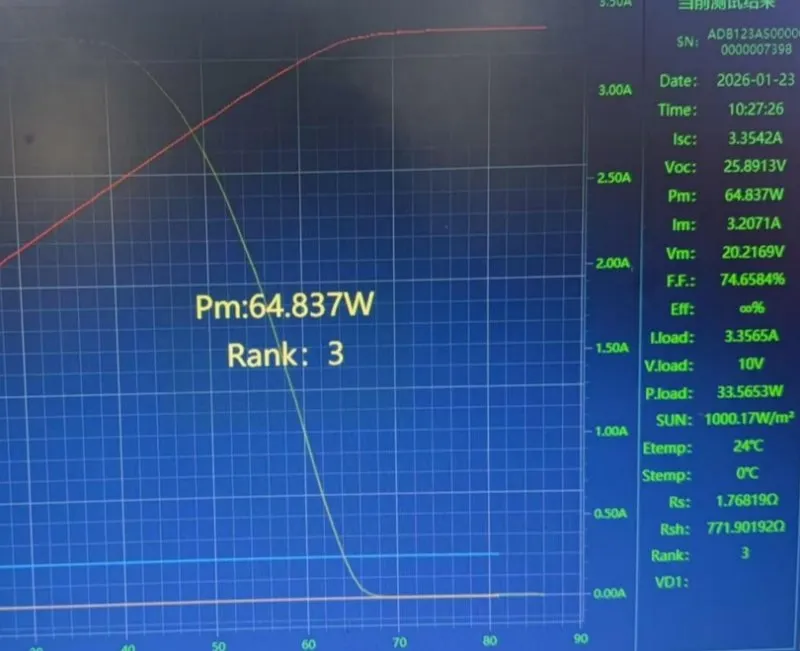
At full sun (1000 W/m²), the UT60H is rated for 60W. In testing, it produced 64.84W — about 8% above its rated output.
That was one sample, so don’t read it as a typical figure. In production, our power tolerance is 0 to +3%: every panel is flash-tested and none ships below its rated power.
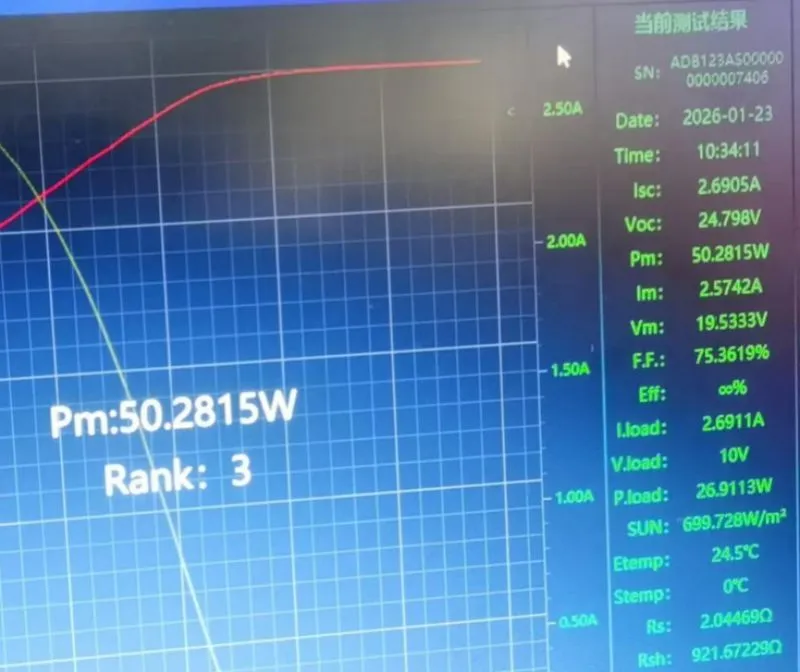
At 700 W/m², the UT60H still delivered more than 50 W.
Haze and Thin Cloud: The Part That Actually Matters
Here’s where it gets more useful. At 800 W/m², roughly a hazy day or thin cloud, the panel produced 52.00W. At 700 W/m², closer to mid-morning sun or thicker haze, it still delivered 50.28W.
| Irradiance | Power Output | Fill Factor |
|---|---|---|
| 1000 W/m² (full sun) | 64.84 W | 74.65% |
| 800 W/m² (haze) | 52.00 W | 75.22% |
| 700 W/m² (thin cloud) | 50.28 W | 75.36% |
Notice something in that third column. The fill factor didn’t drop as the light got weaker — it actually stayed flat, even ticking up slightly. That’s not something every panel does.
A lot of panels lose efficiency, not just raw output, as light gets weaker. Their power curve gets “softer,” meaning more energy gets wasted internally instead of delivered as usable power. This panel held its fill factor steady across all three light levels, which means the drop in output tracked with the drop in sunlight — nothing extra was lost to the panel itself.
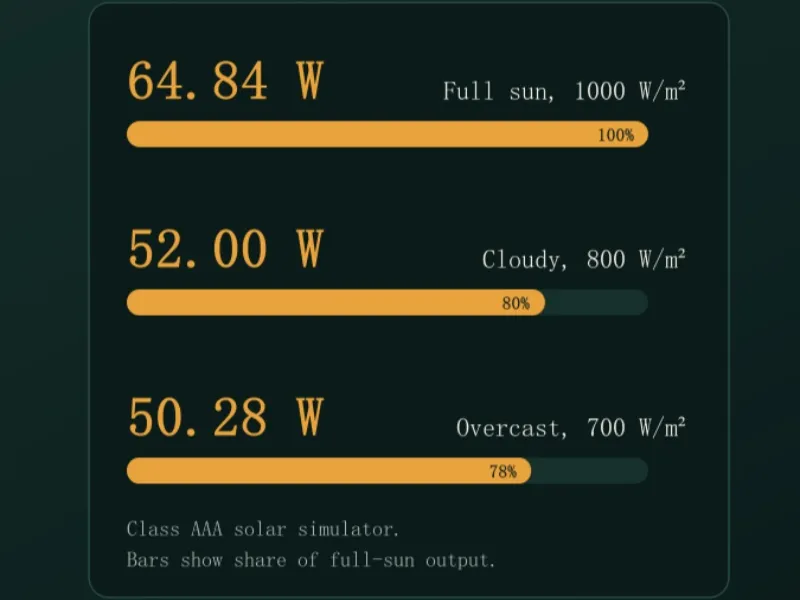
The UT60H retained more than 77% of its maximum output under low-light conditions.
What’s Actually Happening Inside the Panel
The reason for that steady fill factor comes down to something called shunt resistance — essentially, how well the panel prevents current from leaking internally instead of flowing where it’s supposed to go. A panel with high shunt resistance holds its voltage steady even when light drops, instead of sagging.
Why does that matter outside a lab? Because most portable power stations use an MPPT controller — Maximum Power Point Tracking — to find and lock onto the most efficient voltage point as conditions change. If a panel’s voltage swings unpredictably every time a cloud passes or a shadow shifts, the MPPT controller has to keep re-searching for that point, and you lose charging efficiency during the search.
A panel that holds voltage steady under partial light gives the MPPT controller a stable target to lock onto — which matters most exactly when conditions are least ideal: moving vehicles, shifting shade, changing weather.
Why This Matters If You’re Sourcing Panels
If you’re evaluating panels for an outdoor, overlanding, or mobile power product, the peak-sun number on a spec sheet won’t tell you how the panel performs on an actual overcast Tuesday.
What will tell you:
- How much power it holds onto as irradiance drops
- Whether fill factor stays stable or degrades under lower light
- Whether the panel is built to keep an MPPT controller locked on, or fighting to re-find its footing every time a cloud rolls by
Full test data, including IV curve measurements at all three irradiance levels, is available in our lab report (SE-2026-QC-001) — happy to share the complete dataset if you’re evaluating this panel for a specific application.
FAQ
Q1: Does a foldable solar panel work on cloudy days?
Yes, but how much depends on how thick the cloud is. Under thin cloud or haze (700–800 W/m²), our UT60H sample produced 50–52 W from a 60 W rating. Under heavy overcast, expect roughly 10–30% of the rating.
Q2: How much power do solar panels lose in overcast weather?
It depends mostly on how much light gets through. In our laboratory test, output dropped from 64.84W at 1,000 W/m² to 50.28W at 700 W/m², about 22% less. Under heavy overcast, light and output fall much further.
Q3: What is a good fill factor for a portable solar panel?
Generally, a fill factor above 70% indicates good electrical performance. The UT60H maintained more than 74% across all irradiance levels.
Q4: Why is voltage stability important for MPPT controllers?
A stable voltage allows the MPPT controller to remain locked onto the optimal operating point, reducing charging interruptions caused by changing sunlight conditions.
Looking for a Custom Foldable Solar Panel?
At Sola-E, we don’t just publish laboratory data. We design and manufacture custom portable solar panels for:
- RV systems
- Outdoor power stations
- Emergency backup systems
- Overlanding equipment
- Mobile energy applications
Need a customized solution? Contact our engineering team for product specifications, electrical testing data, and prototype support.
Send us your requirements and we reply within 24 hours.