Search “best portable solar panel” and you’ll get a wall of charts.
Wattage. Efficiency. Weight. Price.
They’re not wrong to look at. But they miss the question that actually decides whether you’ll be happy with the panel a year from now:
What is it actually like to own this thing?
I’ve spent years working with portable solar products, and here’s what I’ve learned. A solar panel isn’t just a slab of cells. It’s something you carry, unfold, plug in, pack away, and depend on — sometimes in places where power really matters.
The highest wattage doesn’t guarantee the best experience. Neither does the highest cell efficiency.
A better panel is usually just the one that gets out of your way.
So instead of ranking specs, I want to walk through the five things that actually shape how a panel feels to live with.
1. It Should Be Easy to Use
Solar power is supposed to make life simpler, not send you down a YouTube rabbit hole.
Here’s what the experience should look like:
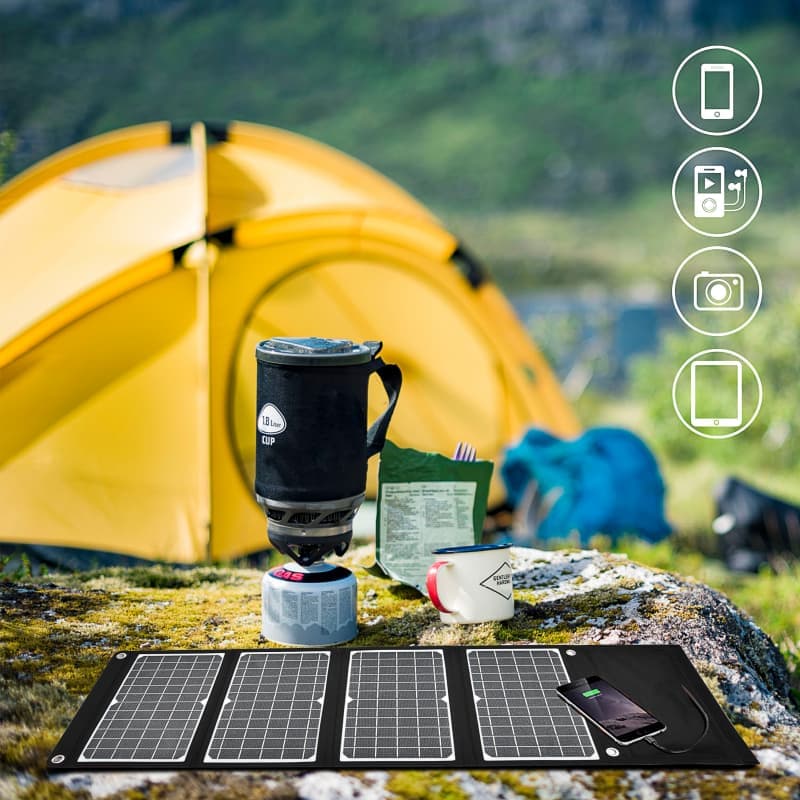
- Unfold the panel
- Point it at the sun
- Plug in the cable
- Start charging
Four steps. That’s it.
But this is usually where people hit their first snag — not because the panel won’t connect to their power station, but because they can’t figure out how.
Solar setups use a handful of different connectors: MC4, XT60, Anderson-style, and a few sizes of DC barrel plug. Even when a power station clearly supports outside panels, picking the right cable or adapter can feel like guesswork.
More adapters in the box isn’t the fix. A connection that’s obvious the first time you look at it — that’s the fix.
Every extra adapter, every vague label, adds a little friction before you’ve even started charging.
2. It Should Be Easy to Match
Most people assume compatibility is simple: if the plug fits, you’re good.
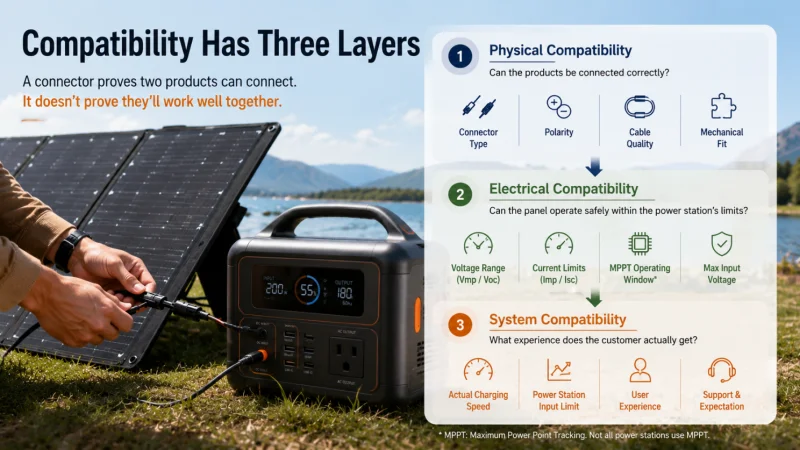
It’s actually got three layers, and it’s worth knowing them.
Physical compatibility. Can you actually plug it in? This covers connector type, polarity, and cable quality. Nothing else matters if this fails.
Electrical compatibility. Can the panel run safely within your power station’s limits? Voltage range, current limits, and — where it applies — the MPPT window all need to line up. Charging starting doesn’t automatically mean every one of these has been checked.
System compatibility. This is the one you actually feel. Charging starts, everything looks fine, and you’re still let down. Maybe your power station already caps its solar input, so a bigger panel doesn’t charge any faster. Maybe the adapter makes the whole setup awkward. Whatever it is, the numbers technically work, but the experience doesn’t.
Compatible and well-matched aren’t the same thing. A connector proves two products can connect. It doesn’t prove they’ll work well together.
3. It Should Be Easy to Carry
Portability isn’t just about the number on the weight spec.
It’s the whole relationship between output, folded size, and how easy the panel is to grab, unfold, and stash away again.
A bigger panel might produce more power — but if you hesitate to bring it along, some of that advantage is already gone before you’ve unfolded it once.
And “portable” means different things to different people:
- An RV owner cares about folded size and where it’ll live in storage
- An overlander cares mostly about weight
- A field technician wants it set up fast
- Someone on a boat needs it easy to secure and handle on deck
There’s no single panel that wins every category. The best one fits how you actually use it. Power only counts if you’re willing to carry it with you.
4. It Should Be Built to Last
A portable panel doesn’t live in a lab. It lives in a truck bed, a backpack, a boat deck — folded, unfolded, rattled around, rained on.
That’s why how it holds up matters just as much as how it performs on day one.
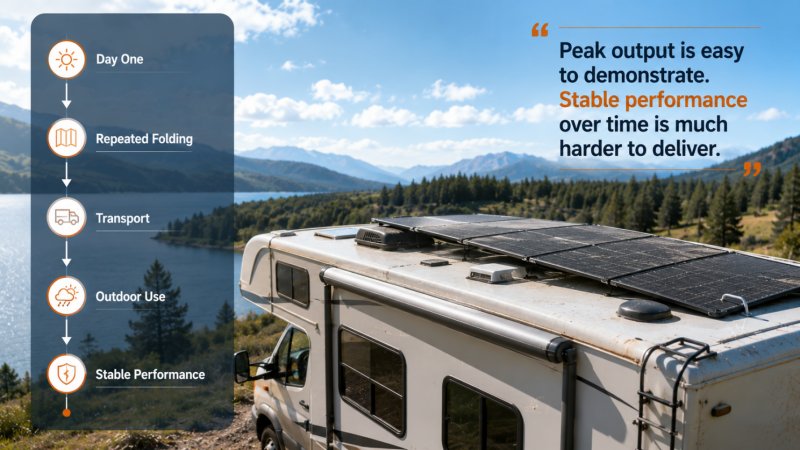
Plenty of panels look great out of the box. The real test is whether they still perform the same way after a year of actual use.
A panel that holds steady output over time is often worth more than one with a slightly higher peak number that fades after a few months.
This comes down to things you won’t find on a spec sheet: how well the panel is laminated, how the cells are connected, how it handles repeated folding, and how consistent the manufacturing is.
But these are exactly the things that decide whether someone recommends the panel to a friend — or sends it back.
Peak output is easy to show off. Staying reliable, month after month, is the harder thing to get right.
5. It Should Be Easy to Own
You don’t judge a product just on the day it arrives. You judge it every time you use it.
A few questions I’d ask myself before buying:
- Is setup actually intuitive, or does it need a manual?
- Is compatibility clear, or am I guessing?
- Does it keep performing after real outdoor use?
- If something’s wrong, can I tell why?
A panel that quietly avoids problems is worth more, long term, than one that only impresses you during the first demo.
You don’t live with a spec sheet. You live with the product.
So, What Actually Makes a Portable Solar Panel “Best”?
People will keep comparing wattage, efficiency, weight, and price — and that’s fine. Those numbers are useful.
But they only tell part of the story.
The better question isn’t which panel ranks highest on paper. It’s which panel creates the fewest headaches over the time you own it.
A genuinely good portable solar panel is:
- Easy to use — you can set it up without a manual
- Easy to match — compatibility is clear, not a guessing game
- Easy to carry — its size and weight actually fit how you use it
- Built to last — steady performance, not just a strong first day
- Easy to own — fewer surprises, fewer support calls, fewer regrets
Specs help you compare panels sitting side by side.
Ownership is what tells you whether you made the right call. Ready to find yours? Browse portable solar panels or check compatibility with your current power station first.
Not sure which panel actually fits how you use power?
Tell us your power station and how you travel — we’ll tell you which panel won’t give you compatibility headaches down the road.
Sam | Solar Application Specialist
With over 10 years of experience in the photovoltaic manufacturing industry, Sam specializes in risk control and application engineering for portable battery chargers and marine solar panel solutions. He helps OEMs and distributors bridge the gap between technical specs and real-world performance.